Dental Zirconia Crown Outsourcing: Comparing Full Contour, Multi-Layer and Layered Zirconia Options
When a dental practice outsources zirconia crowns, the choice of material affects more than the final appearance. It also influences crown design, laboratory processing, finishing requirements, and long-term clinical performance. For both the dentist and the dental technician, the goal is to select a material that suits the individual case rather than simply choosing the strongest or most translucent option.
Full Contour Zirconia (FCZ), Multi-Layer Zirconia, and hand-layered zirconia each offer different advantages. Understanding how they differ helps dental practices make informed decisions and allows the laboratory to produce restorations that meet the clinical prescription.
What Is Full Contour Zirconia (FCZ)?
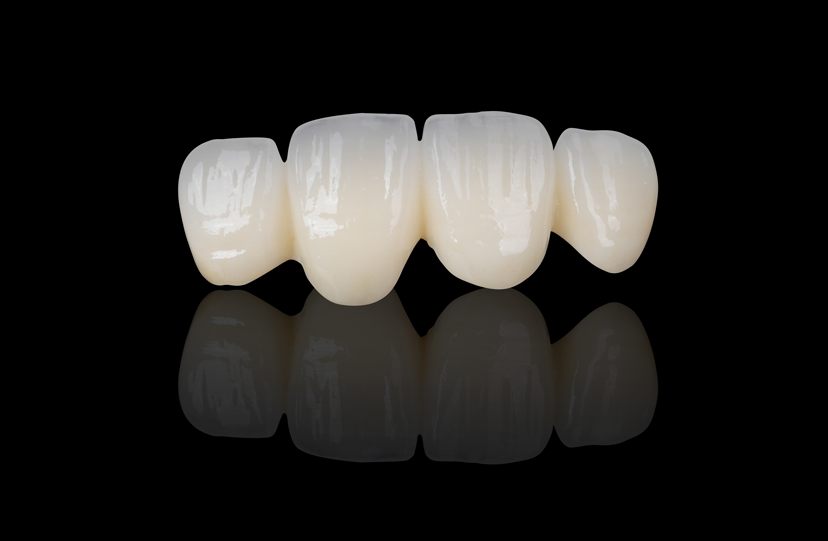
Full Contour Zirconia, also known as monolithic zirconia, is milled as a single zirconia structure without a separate porcelain veneer over a zirconia framework. Depending on the case, the crown may be stained, glazed, or polished to achieve the required shade and surface finish.
One of the main advantages of monolithic zirconia is that it eliminates the separate porcelain veneer, reducing the risk of veneer chipping. However, this does not mean the restoration is immune to fracture or other complications. Material selection, crown thickness, occlusal design, and finishing quality all remain important.
For posterior crowns, full contour zirconia is often a practical option because it combines a streamlined production process with the mechanical properties required for many load-bearing restorations. In cases where aesthetics are a higher priority, the technician must also consider translucency, shade matching, and the characteristics of the selected zirconia formulation.
Full Contour Zirconia vs. Multi-Layer Zirconia vs. Hand-Layered Zirconia
Although these options are sometimes discussed together, they differ in structure, production methods, and aesthetic possibilities.
Full Contour Zirconia
Full contour zirconia is milled from a zirconia blank and finished without adding a separate porcelain veneer. This approach can reduce the number of manual layering steps and avoids veneer-related chipping.
The final appearance depends on the zirconia formulation, shade selection, crown position within the blank, and finishing technique. Monolithic zirconia is not a single uniform material category: some formulations prioritise strength, while others provide greater translucency.
For dental practices, the key is to select a formulation that meets the clinical requirements while providing an acceptable aesthetic result.
Multi-Layer Zirconia
Multi-layer zirconia blanks are designed with gradual changes in shade and/or translucency through the material. When the restoration is positioned correctly during CAD/CAM nesting, these gradients can help create a more natural-looking transition without requiring a separate porcelain veneer.
From a technician's perspective, blank selection and positioning are important. The height of the crown, the location of the occlusal or incisal area within the gradient, and the prescribed shade all influence the final result.
Multi-layer zirconia can be a useful option when both appearance and the benefits of a monolithic structure are desired. However, the material still needs to be selected according to its indicated use and the demands of the case.
Hand-Layered Zirconia
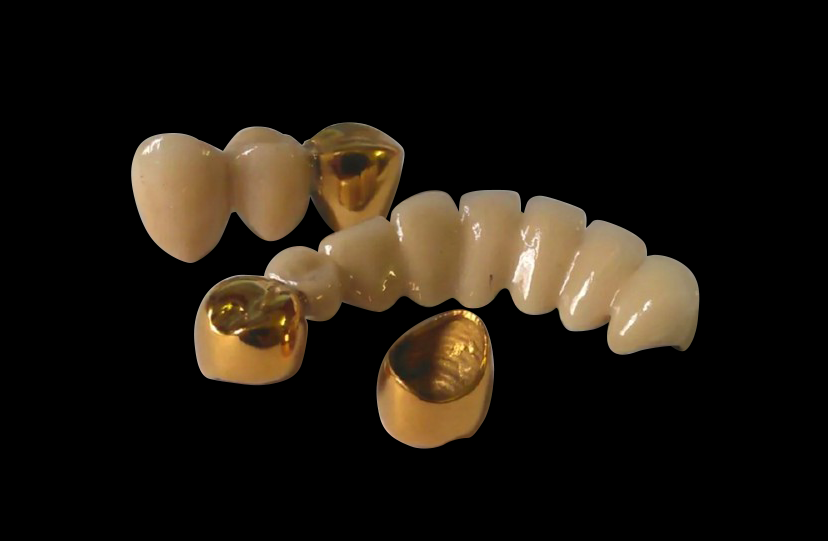
Hand-layered zirconia uses a zirconia framework covered with porcelain. This technique gives the technician more direct control over incisal effects, surface texture, and individual characterisation.
It may be suitable for restorations where aesthetic detail is particularly important. The trade-off is additional laboratory time and the possibility of porcelain chipping. Framework support, veneer thickness, firing procedures, and occlusal design all influence the final restoration.
Layering is not automatically the best choice for every case. The decision should reflect the clinical requirements, the desired appearance, and the available restorative space.
Comparing Zirconia Crown Options
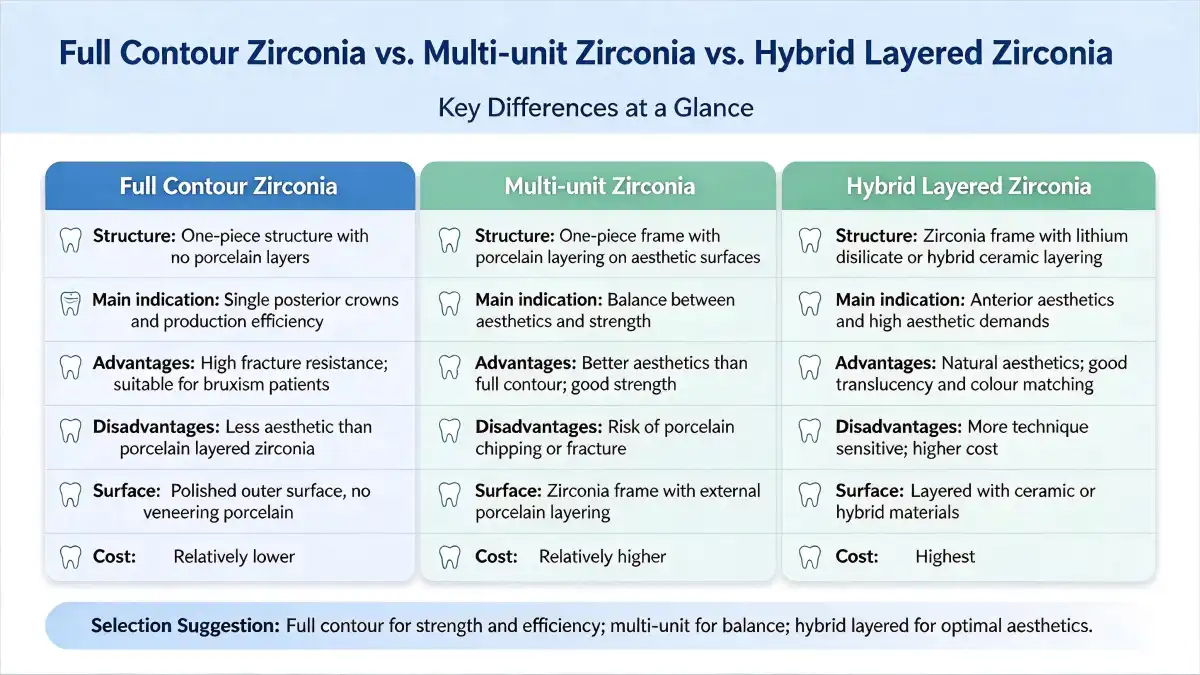
This comparison provides a general guide rather than a universal rule. Zirconia products differ in composition and performance, so the manufacturer's technical documentation and clinical indications should always be considered.
Understanding 3Y, 4Y, and 5Y Zirconia
Zirconia is available in different formulations, and the yttria content influences its crystalline structure and the balance between strength and translucency.
3Y-TZP zirconia generally offers higher strength and lower translucency than more translucent formulations. It is often considered when mechanical performance is a priority.
4Y zirconia typically provides an intermediate balance between strength and translucency, although the exact properties depend on the product.
5Y zirconia generally offers greater translucency but lower strength than conventional 3Y-TZP.
These are broad material trends, not guaranteed values for every product. When comparing flexural strength, dental professionals should refer to the manufacturer's current technical data and check whether the figures were obtained using comparable test methods.
Strength alone does not determine whether a material is suitable for a particular crown. Restoration thickness, shape, occlusal loading, and finishing quality also influence performance. For bridges, connector dimensions and framework design are additional considerations.
When available space is limited or occlusal loading is high, the dentist and laboratory should confirm that the selected material and restoration design meet the manufacturer's requirements.
When Is Monolithic Zirconia a Practical Choice?
Monolithic zirconia is commonly considered for posterior crowns because it avoids a separate porcelain veneer that could chip under occlusal loading. Depending on the material and clinical situation, it may also be considered for selected patients with heavy occlusal forces.
Patients with bruxism or other parafunctional habits require individual assessment. Choosing a high-strength material does not replace appropriate occlusal management, sound restoration design, or regular clinical follow-up.
Zirconia is also used for selected implant-supported crowns and bridges. For multi-unit and full-arch restorations, framework geometry, connector dimensions, occlusion, and implant configuration require particular attention. The appropriate material and design depend on the clinical prescription and the specific zirconia system.
Multi-layer zirconia may be useful when shade transitions and translucency are important, but a monolithic structure is preferred. Hand-layered zirconia may be considered when greater control over fine aesthetic details is required.
For anterior restorations, the shade of the underlying tooth or abutment, available restorative space, and the patient's aesthetic expectations all influence the material choice.
What Information Should Be Included When Outsourcing a Zirconia Crown?
A successful zirconia crown begins with a clear prescription. Missing shade information, unclear preparation margins, or incomplete occlusal details can lead to avoidable questions and production delays.
When submitting a case for zirconia crown outsourcing, dental practices should provide:
Tooth number and restoration type.
Complete scan data or other required case records.
Clearly identifiable preparation margins wherever possible.
Prescribed shade and relevant shade photographs or reference images.
Information about the opposing dentition, contacts, and occlusal requirements.
Material or translucency preferences when clinically indicated.
Required delivery date and any special instructions.
The laboratory should review the submitted information and clarify uncertainties before production begins. Resolving a question at the prescription stage is generally easier than correcting a mismatch after milling, sintering, and finishing have been completed.
Clear communication also helps both parties establish expectations for the final restoration and delivery schedule.
From CAD/CAM Design to Final Quality Inspection
Although individual laboratories may use different equipment and procedures, zirconia crown production commonly involves several stages.
1. Digital Scanning and Design
The technician reviews the scan data and designs the restoration according to the preparation margins, proximal contacts, occlusion, and required contours. Accurate scan data and a clear prescription provide the foundation for the subsequent production steps.
2. CAD/CAM Milling
The crown is milled from a zirconia blank, commonly in a pre-sintered state. The CAM workflow accounts for the material's expected shrinkage during sintering.
The selected blank and milling strategy should be appropriate for the restoration and the material manufacturer's instructions.
3. Sintering
After milling, the restoration is sintered according to the specified cycle for the zirconia product. Sintering parameters vary between materials and systems, so a single generic protocol should not be applied to every blank.
4. Staining, Glazing, and Polishing
The crown is finished according to the shade requirements, material characteristics, and clinical prescription. Depending on the case, finishing may include staining, glazing, polishing, or a combination of these techniques.
Surface finishing deserves particular attention. Adjusting zirconia can leave scratches or a roughened surface, so the adjusted area should be polished using an appropriate zirconia polishing system. Research on zirconia restorations has examined the relationship between surface treatment and wear of opposing enamel, with findings depending on the material and finishing protocol.
For this reason, an adjusted zirconia surface should not simply be left rough. Appropriate polishing is an important part of finishing and clinical maintenance.
5. Final Quality Inspection
Before shipment, the laboratory checks the restoration against the prescription. Depending on the case and the laboratory's quality procedures, this may include marginal fit, proximal contacts, occlusion, shade, contour, and surface finish.
Consistent inspection helps identify issues before delivery and supports a more predictable outsourcing workflow.
What Affects the Cost of Zirconia Crown Outsourcing?
The cost of outsourcing a zirconia crown depends on more than the price of the material blank. The zirconia formulation, restoration type, design complexity, aesthetic characterisation, finishing requirements, order volume, shipping, and turnaround time can all affect the quotation.
A single posterior crown is different from a complex multi-unit bridge or full-arch restoration. The amount of design work and the production requirements may vary considerably.
When comparing dental laboratories, practices should check what is included in the quoted price. Important points include material selection, staining and glazing, quality inspection, delivery, communication, and remake terms.
A lower unit price may not provide the best overall value if essential services are excluded or unclear communication leads to additional adjustments and remakes. Consistent quality and a reliable workflow are important parts of the outsourcing decision.
How to Choose a Dental Laboratory for Zirconia Crown Outsourcing
A reliable dental laboratory partner should offer consistent production, clear communication, and a workflow that fits the practice's needs. Before transferring a large volume of cases, practices may wish to evaluate a sample case and review the result against their clinical and operational requirements.
Consider the following points when assessing a laboratory:
Material traceability: Can the laboratory identify the zirconia product used for each case and maintain appropriate production records?
Digital workflow: Which scan formats can it accept, and how are unclear margins or missing case information handled?
Quality control: What checks are performed before the restoration is shipped?
Communication: Is there a clear process for discussing shade, design, and prescription questions?
Turnaround and delivery: What is the usual production time, and how are delays communicated?
Documentation: Can the laboratory provide relevant quality-system and regulatory documentation for the markets it serves?
Regulatory statements should be specific and accurate. For example, FDA registration or listing should not be described as FDA approval. Practices should verify the requirements that apply to the products and markets involved.
Ultimately, a good outsourcing relationship depends on more than price. Consistent communication, clear case requirements, and an agreed quality process help both the practice and the laboratory work more efficiently.
Care After Placement
Zirconia crowns require routine oral hygiene and professional follow-up, just like other fixed restorations. Patients should brush twice daily, clean between their teeth, and attend regular dental examinations.
During follow-up, the clinician can assess the crown, surrounding tissues, proximal contacts, and occlusion. If chairside adjustment is required, the adjusted zirconia surface should be polished appropriately.
For patients with bruxism or other parafunctional habits, the clinician may consider an occlusal splint based on an individual assessment.
FAQ
What are the main types of zirconia crowns?
Common options include full-contour monolithic zirconia, multi-layer zirconia, and hand-layered zirconia. Monolithic and multi-layer crowns are fabricated as a single zirconia structure, whereas hand-layered crowns use a zirconia framework covered with porcelain.
Is full contour zirconia suitable for posterior crowns?
Full-contour zirconia is often considered for posterior crowns because it does not require a separate porcelain veneer. The specific formulation, available thickness, restoration design, and occlusion should still be evaluated for each case.
Is 5Y zirconia stronger than 3Y zirconia?
Generally, conventional 3Y-TZP offers higher strength, while 5Y zirconia tends to provide greater translucency. The technical data and indicated uses of the specific product should guide material selection.
Does monolithic zirconia eliminate all chipping and fracture risks?
No. Monolithic zirconia eliminates the separate porcelain veneer and the associated veneer-chipping failure mode. The zirconia restoration itself can still fracture, so material selection, design, occlusion, and finishing remain important.
What information should a practice provide when outsourcing a zirconia crown?
Practices should provide complete scan data, tooth and restoration details, shade information, relevant photographs where available, occlusal requirements, and the required delivery date. Any unclear details should be confirmed with the laboratory before production.
What should be checked before a zirconia crown is shipped?
The laboratory should check the restoration against the prescription, including marginal fit, proximal contacts, occlusion, shade, contour, and surface finish. The exact inspection process depends on the laboratory's quality procedures and the restoration type.
Zirconia Crown Outsourcing with HYC Dental Laboratory
HYC Dental Laboratory works with dental clinics and laboratories on zirconia crowns and other dental restorations. Each outsourcing case starts with understanding the restoration requirements, including the type of crown, shade expectations, available scan files, and required turnaround time.
Providing these details at the beginning helps clarify the production requirements and reduces avoidable delays. For practices seeking a dental laboratory partner, direct communication about case needs and workflow expectations is a useful first step.
To discuss zirconia crown outsourcing or other laboratory requirements, contact info@hycdentallab.com or visit hycdentallab.com.
References
References should be checked against the original publications before the article is published. Complete bibliographic details should be added where available, and each source should directly support the claim for which it is cited.
Shah N, Nerkar H, Badwaik P, Ahuja B, Malu R, Bhanushali N. “An evaluation of antagonist enamel wear opposing full-coverage zirconia crowns versus other ceramics full-coverage crowns and natural enamel – An umbrella review.” Journal of Indian Prosthodontic Society. 2024;24(3):217–224. https://doi.org/10.4103/jips.jips_32_24
International Organization for Standardization. ISO 6872: Dentistry — Ceramic Materials. Confirm the applicable edition before publication.
YOU MAY LIKE
_1779414398631.webp "Malong Bridge(All-on-X)")