How Should Labs Source Complete Acrylic Denture for Full-Arch Cases?
Labs sourcing a complete acrylic denture for full-arch cases should prioritize suppliers with ISO 13485:2016 certification, appropriate regulatory compliance for the target market, and consistent fit accuracy. Evaluate turnaround time, customization capability, material traceability, and remake history before committing. A reliable manufacturer delivers heat-cured PMMA restorations with precise occlusion, natural aesthetics, and a documented quality management system — reducing chairside adjustment and supporting consistent clinical outcomes.
Introduction
Full-arch edentulism affects a significant portion of the adult population. According to the American College of Prosthodontists, approximately 12 million Americans are completely edentulous, while 36 million are edentulous in one jaw. For dental laboratories and clinics managing high case volumes, sourcing reliable full-arch removable prostheses is not a peripheral concern — it sits at the center of operational efficiency and clinical outcomes.
The challenge is not simply finding a manufacturer. It is finding one that delivers consistently precise restorations, meets applicable regulatory requirements, and integrates smoothly into your production schedule. This guide walks through everything labs and procurement teams need to evaluate when sourcing full-arch acrylic prostheses.
What Is a Complete Acrylic Denture?
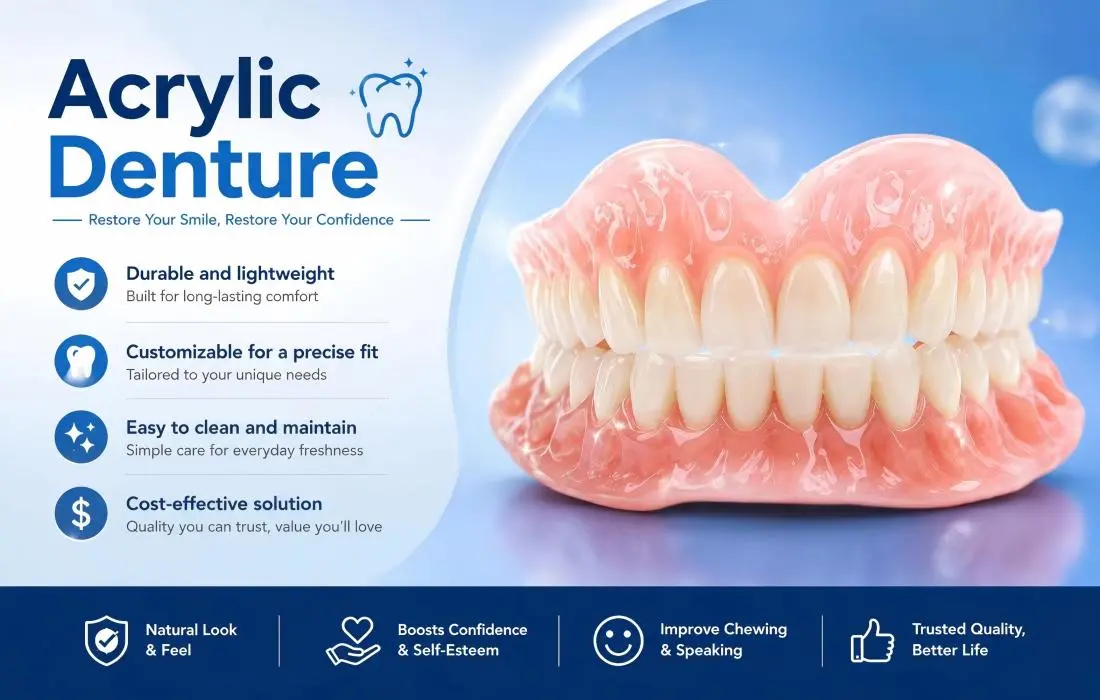
The entire upper or lower jaw can be replaced with a Complete Acrylic Denture, which is a removable full-arch replacement. It rests on the soft tissues in the mouth and the residual alveolar ridge. Tissue support, not implant anchoring, gives it stability and retention.
Core Material Composition
The base is made from heat-cured polymethyl methacrylate (PMMA) resin. This type of resin is stable in size, easy to shape, and has a long history of use in clinical settings. Prosthetic teeth, which are also made of acrylic, are attached to the base and color-matched to look like natural enamel. The combination makes a restoration that can be relined and is suitable for patients who cannot or do not choose implant-supported options.
Clinical Fabrication Pathway
There is a set order to production: preliminary impressions, final impressions, jaw relation records, wax try-ins for cosmetic and dental confirmation, processing in the lab, and delivery. To make sure that the vertical dimensions are correct and the occlusal scheme is correct, the prescribing clinician and the fabricating laboratory must communicate clearly at every step.
Key Benefits for Labs and Clinics
Full-arch acrylic prostheses have clear benefits in both the buying process and the way they are used in the clinic. Here are the main benefits that labs should consider:
Affordability at scale: PMMA-based restorations are generally less costly to produce than metal-reinforced frameworks or implant-supported solutions, so they can be made in larger quantities with predictable production costs.
In-office adjustability: Acrylic resin can be relined and repaired at chairside when clinically appropriate, which can reduce the need for some remakes and make things easier for both the clinic and the lab.
Faster fabrication cycle: Heat-curing is an established denture fabrication method, which can support predictable turnaround times for labs working on time-sensitive cases.
Metal-free construction: All-acrylic construction does not require a metal framework, making it an option when a metal-free denture design is preferred.
Shock-absorbing occlusal load distribution: Compared with harder restorative materials, acrylic denture teeth can provide different force-distribution characteristics, which may be considered when selecting materials for removable prostheses.
The Complete Acrylic Denture remains a common type of restoration used in both general and prosthodontic dental offices because of these useful features.
Advantages Over Alternative Full-Arch Solutions
The PMMA full-arch prosthesis is different from cast metal partial frameworks, flexible nylon prostheses, or implant-supported overdentures in both clinical and financial terms. Dentures that are strengthened with metal can provide greater structural reinforcement, but they may take longer to fabricate and cost more to produce. Implant-supported restorations offer a different treatment approach, but patients must be able to undergo the required procedures and meet the clinical requirements for implant treatment.
The heat-cured acrylic choice is suitable for people who are missing teeth and need a cost-effective, esthetically pleasing, and functional way to replace their teeth. This means a predictable case workflow and a well-understood manufacturing method for labs.
Limitations to Acknowledge
There are limits to every type of restoration. When high occlusal forces are applied, acrylic resin is more likely to fracture than some metal-reinforced alternatives. The base material can also develop surface cracks if it comes in contact with some cleaning products or very rapid temperature changes. If the unreacted monomer content is not properly controlled during processing, it may contribute to tissue irritation in susceptible patients.
Because residual ridges can change over time, relining or rebasing may become necessary, and complete replacement may eventually be required depending on the patient's oral condition, denture wear, fit, and maintenance. When labs source these restorations, they should make sure that the manufacturer uses an appropriate denture-base material and follows controlled polymerization and finishing procedures.
Comparison: Heat-Cured PMMA vs. Alternative Denture Materials
| Feature | Heat-Cured PMMA | Cold-Cured Acrylic | Flexible Nylon | Metal-Reinforced |
|---|---|---|---|---|
| Fracture resistance | Moderate | Lower | High flexibility | High |
| Residual monomer | Very low | Higher | Minimal | Minimal |
| Adjustability | Excellent | Good | Limited | Limited |
| Fabrication time | Moderate | Fast | Moderate | Long |
| Cost | Low–Moderate | Low | Moderate | High |
| Reline compatibility | Excellent | Good | Poor | Poor |
When it comes to physical accuracy and material performance, heat-cured PMMA offers established advantages over cold-cured options in denture fabrication. These are two factors that can directly affect the consistency of denture fabrication and fit.
Clinical Indications
Complete Acrylic Dentures are recommended for patients who have no teeth left at all, including those who have just had a full arch extracted and need immediate or definitive prosthetic rehabilitation. They may also be used as interim restorations while implants are being integrated or as conventional dentures for patients who do not choose implant-supported treatment. Patients who can't have surgery because of uncontrolled systemic conditions or who are known to be allergic to acrylic need a different evaluation.
Manufacturing Workflow
The following steps make up a quality-controlled production process: digital or traditional impression scanning, 3D occlusal articulation, tooth arrangement, wax try-in fabrication, flask investing, heat-press curing at a controlled temperature and pressure, deflasking, finishing, polishing, and a final quality check. Checking the adaptation, the distribution of occlusal contacts, and the uniformity of the shade are all important quality control steps that must be completed before shipment.
Cost Factors in Full-Arch Acrylic Prosthesis Sourcing
Prices change based on the type of PMMA used, the brand of teeth chosen, the level of customization needed, the size of the order, the cost of approval, and the method of shipping. When labs buy in bulk, they can usually get lower unit costs through volume purchasing agreements. Faster shipping costs more, but it may be worth it when patients need help right away.
How to Choose a Supplier
To choose the right Complete Acrylic Denture maker, you have to look at a lot of factors at once. A good buying plan is made up of the following items:
Regulatory certification: Make sure that the company has ISO 13485:2016 certification, maintains the appropriate regulatory status for the target market, and can provide relevant compliance documentation for the markets it serves.
Material traceability: Make sure that the PMMA material and acrylic teeth can be traced to their respective manufacturers and that the supplier can provide relevant material documentation for the target market.
First-time fit rate: Ask for written figures on the rate of remakes. Process control is shown by suppliers with low remake rates, not just product output.
Turnaround commitment: Standard production cycles should take four to five working days, with options for flash delivery for cases that need to be completed quickly.
Customization depth: Each full-arch case has its own standards for vertical measurement, color, and arch shape. Make sure the supplier makes restorations that are customized for each case and not based on templates.
After-sales warranty: An organized warranty that covers free repair or reproduction during the service period shows that the seller is responsible.
Spending time on source qualification up front keeps clinical schedules and patient care from being interrupted in ways that cost a lot of money later on.
Maintenance Recommendations
Patients should take off their dentures every night to let their mucosa rest. Cleaning dentures every day with a soft-bristle brush and a suitable denture cleaner will help keep the surface in good condition. Ultrasonic cleaning baths should only be used with solutions that are recommended by the denture or cleaning-product manufacturer. To help prevent acrylic from drying out and losing its shape, prostheses should be stored as recommended by the manufacturer and should not be allowed to dry out. Labs should tell clinicians to schedule fit checks as clinically appropriate and proactive relining checks when changes in fit are observed.
Conclusion
It takes more than comparing unit prices to find the right full-arch acrylic prostheses, such as a Complete Acrylic Denture. When labs and purchasing teams evaluate factors such as supplier approval, material traceability, remake history, and turnaround reliability, they can support better clinical outcomes and reduce operational disruptions. Heat-cured PMMA remains a standard material for a Complete Acrylic Denture because it is cost-effective, easy to shape, and widely used for denture-base applications. A well-organized purchasing method based on quality standards and supplier accountability can help safeguard both laboratory profitability and high standards of patient care. By selecting a reliable supplier and maintaining consistent quality-control requirements, laboratories can also improve the long-term consistency of every Complete Acrylic Denture. For large-scale dental procurement, careful evaluation of materials, production capabilities, and delivery performance can further support reliable sourcing of a Complete Acrylic Denture.
FAQ
What is a complete acrylic denture?
A complete acrylic denture is a removable full-arch prosthesis that replaces all teeth in the upper or lower arch. The denture base is commonly made from acrylic resin such as heat-cured PMMA, with artificial teeth attached to the base.
What materials are used in a complete acrylic denture?
The denture base is commonly made from polymethyl methacrylate (PMMA) resin, while the artificial teeth are typically made from acrylic-based materials. The specific material and processing method should be selected according to the clinical requirements and applicable regulatory requirements of the target market.
What is the difference between heat-cured PMMA and cold-cured acrylic dentures?
Heat-cured PMMA is polymerized using controlled heat, while cold-cured acrylic uses an autopolymerization process. Heat-cured PMMA is widely used for denture bases and can provide low residual monomer levels when properly processed.
How long does a complete acrylic denture last?
The service life of a complete acrylic denture varies according to fit, occlusion, material, oral conditions, cleaning habits, and wear. Relining, rebasing, repair, or replacement may become necessary as the residual ridge changes or the denture becomes worn.
Can a complete acrylic denture be repaired if it fractures?
Yes. Acrylic denture bases can generally be repaired or relined when clinically appropriate. The laboratory should evaluate the cause and location of the fracture before determining whether repair, rebasing, or replacement is the most suitable option.
How long does it take to manufacture a complete acrylic denture?
Production time depends on the laboratory workflow, case requirements, try-in requirements, and shipping method. For B2B dental laboratory sourcing, a standard production turnaround of four to five working days may be available for suitable cases, while expedited options may be available for urgent orders.
Is a complete acrylic denture suitable for upper and lower arches?
Yes. Complete acrylic dentures can be fabricated for either the maxillary arch or mandibular arch when all teeth in the respective arch are missing. The design and occlusal setup should be based on the patient's clinical requirements.
What information does a dental laboratory need to order a complete acrylic denture?
The required information depends on the laboratory's workflow and the manufacturer's process. Typical case information may include impressions or digital scans, jaw relation records, tooth shade, tooth selection, occlusal requirements, and other case-specific instructions.
Can complete acrylic dentures be digitally designed?
Yes. Digital workflows can be used for steps such as impression scanning, denture design, tooth arrangement, and occlusal planning. The final manufacturing method depends on the laboratory's equipment, materials, and quality-control process.
What should dental labs look for when choosing a complete acrylic denture supplier?
Dental labs should evaluate material traceability, quality-control procedures, regulatory documentation, customization capability, turnaround time, remake history, communication, and after-sales support. A supplier should also be able to provide documentation relevant to the target market.
Are complete acrylic dentures suitable for B2B dental laboratory procurement?
Yes. Complete acrylic dentures can be sourced by dental laboratories and clinics as part of a B2B procurement program. For recurring orders, laboratories should evaluate production consistency, case communication, turnaround reliability, pricing, packaging, shipping, and warranty terms.
What is the difference between a complete acrylic denture and an implant-supported denture?
A complete acrylic denture is a removable prosthesis supported primarily by the oral tissues and residual ridge. An implant-supported denture uses dental implants for additional support and retention. The appropriate option depends on the patient's clinical condition, treatment plan, and preferences.
How should complete acrylic dentures be cleaned and stored?
Complete acrylic dentures should be cleaned regularly using appropriate denture-cleaning methods and should be handled according to the manufacturer's instructions. Patients should generally remove dentures at night unless their dental professional provides different instructions.
Partner With HYC for Precision Full-Arch Acrylic Restorations
Every Complete Acrylic Denture case that HYC makes is backed by 22 years of experience in the business. As a reliable company that makes restorations, we have ISO 13485:2016 certification and can provide relevant regulatory compliance documentation for the markets we serve. Our PMMA materials are selected according to applicable material and production requirements. Four to five days is the standard turnaround time, and next-day flash delivery is an option. For one year, our guarantee on removable prostheses covers free replacement or repair. To get a quote, email our team at info@hycdentallab.com or go to hycdentallab.com.
References
1. Felton, D. A. (2016). Edentulism and Comorbid Factors. Journal of Prosthodontics, 25(5), 346–352.
2. Phoenix, R. D., Cagna, D. R., & DeFreest, C. F. (2008). Stewart's Clinical Removable Partial Prosthodontics (4th ed.). Quintessence Publishing.
3. Zarb, G. A., Hobkirk, J., Eckert, S., & Jacob, R. (2012). Prosthodontic Treatment for Edentulous Patients: Complete Dentures and Implant-Supported Prostheses (13th ed.). Elsevier Mosby.
4. Anusavice, K. J., Shen, C., & Rawls, H. R. (2013). Phillips' Science of Dental Materials (12th ed.). Elsevier Saunders.
5. Darvell, B. W. (2018). Materials Science for Dentistry (10th ed.). Woodhead Publishing.
6. American College of Prosthodontists. (2023). Facts & Figures: Edentulism in the United States. ACP Foundation.
YOU MAY LIKE
.webp "Co-Cr Crown (Cobalt-Chrome)")