How Should Buyers Evaluate Titanium Partials for Dental Labs?
For dental laboratories evaluating Titanium Partials, key factors include framework fit, material biocompatibility, CAD/CAM milling accuracy, regulatory compliance, and supplier reliability. A well-designed titanium partial framework should provide a precise fit, be lightweight and comfortable, and offer good corrosion resistance. Before making a purchase, buyers should verify the supplier's applicable FDA registration and device listing status, ISO 13485 quality management system, material documentation, and production capacity. Clear warranty terms and reliable remake support are also important when evaluating a long-term production partner.
Introduction
In the past ten years, removable partial dentures have continued to evolve. For many years, cobalt-chromium frameworks were widely used. Today, dental laboratories and clinicians also consider titanium frameworks because they combine lightweight design, biocompatibility, and functional performance. The use of CAD/CAM technology has also made digitally designed titanium partial frameworks increasingly accessible to dental laboratories.
When purchasing managers, lab owners, and prosthodontists evaluate titanium partial frameworks, they need to consider more than price alone. Material grade, milling accuracy, clinical fit, workflow compatibility, and logistics all play a role in the sourcing decision. This guide explains the key factors buyers should consider before placing an order for Titanium Partials.
What Are Titanium Partials?
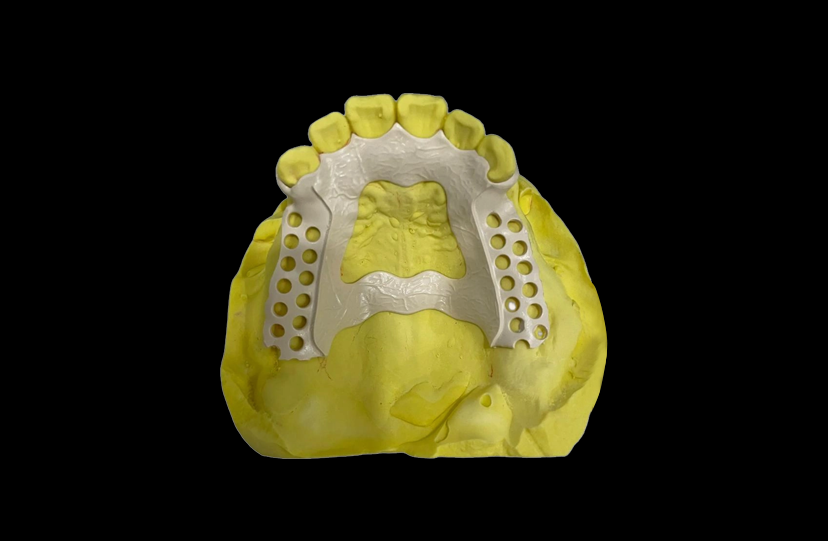
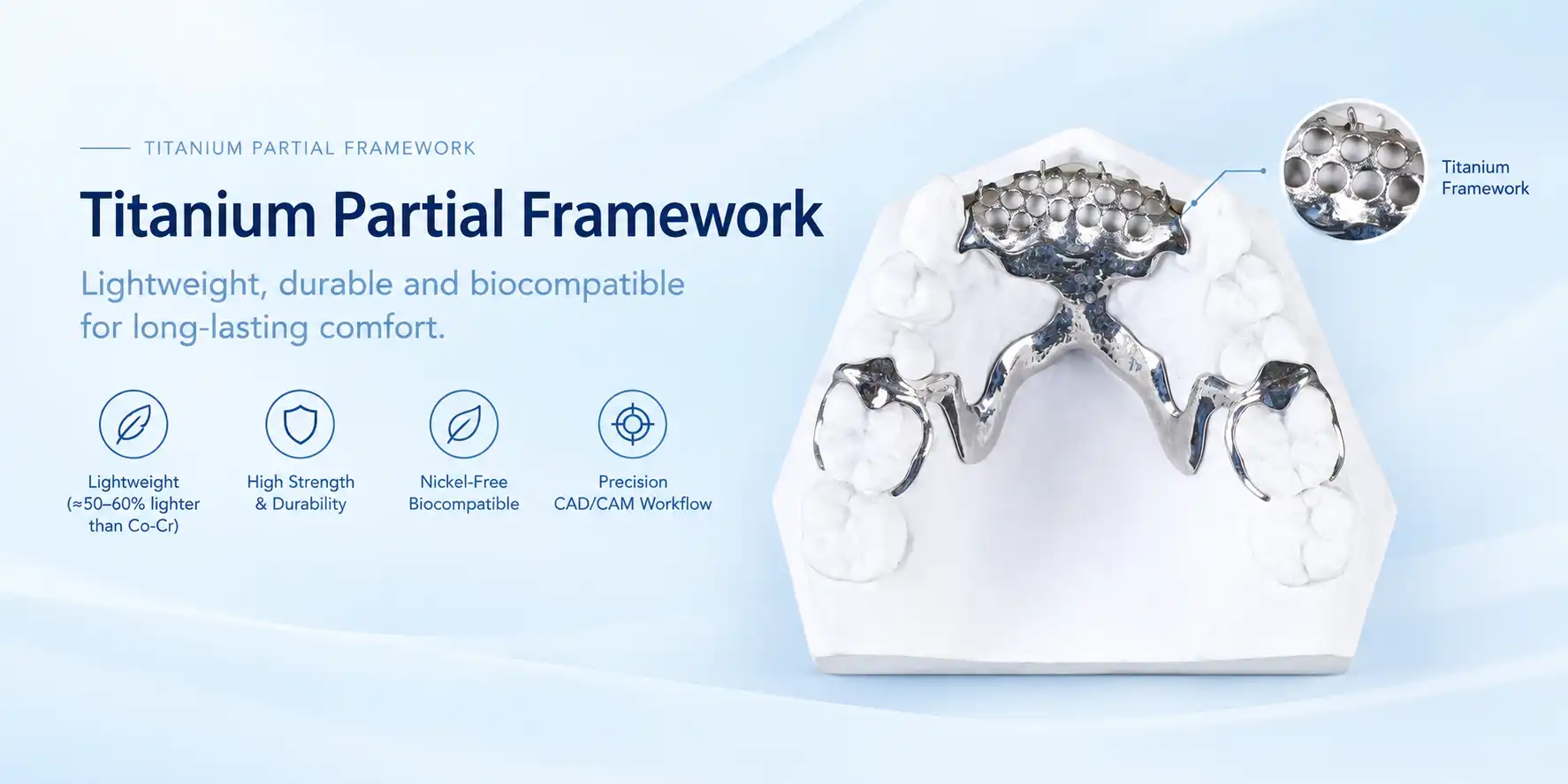
CAD/CAM milling is used to manufacture Titanium Partials, which are removable partial denture frameworks made from titanium alloys such as Grade 5 (Ti-6Al-4V) or other grades specified for the intended application. Unlike cast cobalt-chromium frameworks, milled titanium frameworks are manufactured by subtractive machining from titanium disks or blanks with documented material specifications. This digital manufacturing process can help reduce dimensional variation associated with conventional casting.
The framework can include major and minor connectors, rests, retentive clasps, and tissue-bearing saddle areas. These components are digitally designed according to the patient's scan or physical impression and the prescribed prosthetic design. Titanium is widely used in medical and dental applications because of its favorable strength-to-weight ratio and biocompatibility.
What Are the Key Benefits of Titanium Partial Frameworks?
When dental professionals specify titanium frameworks, several potential clinical and operational benefits may be considered.
Here are the main characteristics of titanium partial frameworks:
Exceptional biocompatibility: Titanium is widely recognized for its biocompatibility and corrosion resistance. It may be considered for patients with a documented sensitivity to certain base-metal alloys, depending on the clinical situation and material specifications.
Superior strength-to-weight ratio: Titanium offers a high strength-to-weight ratio and can produce a lighter framework than comparable cobalt-chromium designs. A lightweight framework may contribute to patient comfort.
CAD/CAM dimensional precision: Digital design and milling provide a controlled manufacturing workflow and allow the framework to be produced directly from a digital design file. This can improve repeatability and reduce some variations associated with conventional casting.
These characteristics can support efficient laboratory workflows, consistent framework production, and patient-focused removable prosthetic treatment.
Advantages Compared to Alternative Frameworks
Titanium Partials offer a combination of lightweight design, strength, corrosion resistance, and digital manufacturability. Cobalt-chromium frameworks remain widely used because of their established clinical application and mechanical properties. Flexible thermoplastic partials provide another option when flexibility and metal-free aesthetics are important.
Titanium can provide a balance between rigidity and lightweight construction. Because digitally designed titanium frameworks can be produced from saved CAD files, replacement frameworks may be reproduced from the original digital design when the clinical situation allows. This can simplify the workflow when a replacement is required.
Disadvantages and Honest Considerations
There are limitations to every framework material. Titanium can be more difficult to adjust chairside than some conventional alloys because of its material properties. Care should be taken when adjusting or modifying clasp areas, and repairs may require specialized laboratory equipment and techniques.
CAD/CAM milling and titanium materials can also involve higher production costs than conventional casting workflows, particularly when order volumes are low. When sourcing titanium frameworks from overseas suppliers, procurement teams should verify the applicable regulatory documentation, material traceability, and supplier quality-system information rather than relying on certification claims alone.
Comparison: Titanium vs. Cobalt-Chromium vs. Flexible Partials
| Factor | Titanium | Cobalt-Chromium | Flexible Thermoplastic |
|---|---|---|---|
| Biocompatibility | Excellent | Good | Good |
| Weight | Lightweight | Heavier | Very light |
| Manufacturing | CAD/CAM milling | Casting or CAD/CAM | Injection molding |
| Precision | Digital workflow | Depends on manufacturing process | Depends on molding process |
| Repairability | May require specialized laboratory techniques | Generally easier to adjust | More limited depending on material |
| Corrosion Resistance | Excellent | Good | Not applicable to metal corrosion |
| Long-term Durability | High | High | Moderate to high depending on material and design |
The appropriate framework material depends on the clinical indication, prosthetic design, patient requirements, laboratory workflow, and budget. Titanium is one option when lightweight construction, digital manufacturing, and material properties are important considerations.
Clinical Indications
Titanium Partials may be considered in several clinical situations, including cases where a lightweight framework is desired or where the clinician is evaluating alternatives to conventional base-metal frameworks. Material selection should be based on the patient's clinical condition, documented material sensitivities, prosthetic design, and professional judgment.
Titanium's strength-to-weight ratio can be useful for posterior removable partial dentures, implant-assisted removable prostheses, and cases where a relatively thin but rigid framework design is required. For multi-location dental groups and dental laboratories managing different types of removable cases, titanium can also provide another framework option within the digital production workflow.
Materials Used in Titanium Partial Production
Grade 5 titanium (Ti-6Al-4V) is commonly used in dental and medical applications. Other titanium grades, including Grade 23 (Ti-6Al-4V ELI), may be specified depending on the material requirements and intended application.
Material traceability is an important consideration when purchasing titanium partial frameworks. Buyers should request appropriate material documentation, such as material specifications, certificates of conformity, and batch or lot information where applicable. Biocompatibility evaluation should also be considered according to the intended use and applicable regulatory requirements.
Manufacturing Workflow
A controlled digital workflow guides the production process for a milled Titanium Partials framework. A precise 3D model is created from a digital scan or physical impression. Based on the prosthodontist's instructions, a CAD technician designs the framework, including clasp arms, rests, major connectors, and saddle areas. The milling program generates the toolpath, and the framework is milled from a documented titanium blank using a multi-axis CNC milling system.
After milling, the framework is finished, polished, and inspected for accuracy. Depending on the laboratory workflow, the framework can then be evaluated on the digital model or articulated model to verify the design and fit before shipping.
Cost Factors
The price per unit of Titanium Partials frameworks depends on several factors. Titanium material costs can be higher than those associated with conventional cobalt-chromium casting workflows. CAD design complexity, including the number of clasps, connectors, rests, and saddle areas, can also affect production time.
Other factors may include quality-control requirements, material documentation, case complexity, expedited production, and shipping requirements. Established dental laboratories may offer different pricing structures based on order volume and long-term cooperation.
How to Choose a Supplier
When looking for a reliable Titanium Partials supplier, buyers should look beyond the price per unit. A suitable production partner should be able to meet the laboratory's manufacturing requirements while providing appropriate quality documentation and dependable service.
Here are important factors that buyers should consider:
Regulatory credentials: Verify the supplier's applicable FDA registration and device listing information for the U.S. market, CE-related documentation where applicable, and ISO 13485:2016 quality management certification when claimed.
Material traceability: Check whether titanium materials are supported by appropriate documentation, including material specifications and batch-level records where applicable.
Turnaround capacity: Review normal production times, the supplier's ability to handle urgent cases, and available shipping options.
Customization depth: Confirm that production is case-specific and based on digital files or physical impressions according to the prescribed design.
After-sales warranty: Ask for clear warranty terms covering applicable repair or replacement conditions.
Remake rate evidence: Where available, ask for case references, quality-control data, or other evidence related to fit and remake performance.
By consistently following these standards, buyers can reduce sourcing risks related to production quality, documentation, logistics, and after-sales service.
Maintenance
Titanium Partial frameworks should be cleaned according to the care instructions provided by the dental professional and laboratory. Patients should use an appropriate soft brush and denture-cleaning product that is compatible with the prosthesis. Cleaning procedures should follow the material and prosthesis manufacturer's recommendations.
Patients should avoid inappropriate chemical solutions that may damage the prosthesis or its components. Regular clinical examinations can help identify changes in fit, clasp condition, framework integrity, or other issues that may require professional attention.
Conclusion
Titanium Partials should be evaluated based on material grade, milling precision, framework design, biocompatibility considerations, supplier documentation, and service reliability. Titanium offers a combination of lightweight construction, strength, corrosion resistance, and digital manufacturability that makes it an important option for removable partial denture frameworks.
For dental laboratories and clinics sourcing titanium partial frameworks, important purchasing considerations include documented material specifications, appropriate regulatory information, ISO 13485 quality management where applicable, confirmed production capacity, quality-control procedures, and clear warranty terms.
FAQ
What are Titanium Partials?
Titanium Partials are removable partial denture frameworks manufactured from titanium alloy. They can be designed digitally and produced using CAD/CAM milling technology. Titanium is commonly considered when a lightweight, rigid, and corrosion-resistant framework is desired.
What grade of titanium is commonly used for dental partial frameworks?
Grade 5 titanium (Ti-6Al-4V) is commonly used in dental and medical applications. Other grades, such as Grade 23 (Ti-6Al-4V ELI), may also be used depending on the material specification and intended application.
Are titanium partial dentures lighter than cobalt-chromium partial dentures?
Titanium generally has a lower density than cobalt-chromium, so a titanium framework can be lighter than a comparable cobalt-chromium framework. The actual weight difference depends on the framework design, dimensions, and material used.
What are the main advantages of titanium partial frameworks?
The main characteristics include a high strength-to-weight ratio, corrosion resistance, biocompatibility, and compatibility with digital CAD/CAM manufacturing. These characteristics can make titanium an option for laboratories and clinicians seeking a lightweight removable framework.
Are titanium partial dentures suitable for metal-sensitive patients?
Titanium is generally considered biocompatible and may be considered for patients with documented sensitivity to certain base-metal alloys. However, material selection should be based on the patient's clinical history, documented sensitivities, and the clinician's professional judgment.
Can titanium partial frameworks be made with CAD/CAM?
Yes. Titanium partial frameworks can be digitally designed and manufactured using CAD/CAM milling. The digital workflow allows the framework design to be stored and potentially reproduced when the clinical situation permits.
Can a titanium partial framework be repaired?
Some titanium framework repairs can be performed using specialized laboratory equipment and techniques. The repairability depends on the type and location of the damage, the framework design, and the laboratory's capabilities.
How long does it take to manufacture a titanium partial framework?
Production time depends on the supplier, case complexity, CAD design requirements, quality-control procedures, and shipping method. HYC's standard production schedule for applicable orders is generally 3–5 business days, while urgent production may be available depending on the case.
How much do titanium partial frameworks cost?
The cost depends on titanium material, framework design, number of components, CAD complexity, production requirements, order volume, and shipping. Dental laboratories should request a case-specific quotation from the supplier.
How should a dental laboratory choose a titanium partial framework supplier?
A dental laboratory should evaluate material documentation, manufacturing technology, CAD/CAM capability, quality-control procedures, regulatory information, turnaround time, warranty terms, communication, and after-sales support. Price should be evaluated together with these factors.
What should I check when buying titanium partial frameworks from an overseas dental laboratory?
Buyers should verify the supplier's company information, applicable regulatory registration or listing status, ISO 13485 certification if claimed, material documentation, production workflow, turnaround time, shipping arrangements, warranty terms, and communication process.
Does FDA registration mean that a titanium partial framework is FDA approved?
No. FDA establishment registration and device listing are not the same as FDA approval, clearance, or authorization. Buyers should verify the specific regulatory status that applies to the establishment and device rather than treating FDA registration or listing as an approval claim.
Are titanium partial frameworks compatible with implant-supported removable prostheses?
Titanium frameworks can be used in certain implant-assisted or implant-supported removable prosthetic designs. The design must be planned according to the implant system, attachment components, occlusion, available space, and clinical requirements.
What information should a dental laboratory provide when requesting a titanium partial framework?
The laboratory should provide the required digital files or physical impression information, framework design requirements, material specifications, implant or attachment information when applicable, and any special instructions from the prescribing clinician. The exact requirements depend on the case.
Partner with HYC — Titanium Partials Manufacturer
HYC has been making dental restorations for 22 years and brings that experience to every case. HYC provides Titanium Partials for dental laboratories and dental practices and follows an ISO 13485:2016 quality management system. Applicable regulatory and material documentation can be provided according to the product and market requirements.
Our normal turnaround time is 3–5 days for applicable orders, with expedited production available for urgent requests depending on case requirements. Each framework is designed according to the individual case and can be reproduced from digital files when appropriate.
To request a quotation, email us at info@hycdentallab.com or visit hycdentallab.com.
References
Craig, R.G., & Powers, J.M. — Restorative Dental Materials, Elsevier Mosby, 2012.
Wataha, J.C. — "Biocompatibility of Dental Casting Alloys: A Review," Journal of Prosthetic Dentistry, 2000.
Lüthy, H., et al. — "Strength and Reliability of Four Types of All-Ceramic Dental Restorations Assessed by Biaxial Flexure Tests," Dental Materials, 2005.
Ramakrishnaiah, R., et al. — "Biocompatibility Assessment of Dental Materials," Current Pharmaceutical Design, 2016.
Kohal, R.J., et al. — "Titanium-Reinforced Polyetheretherketone Frameworks: An In Vitro Study," Clinical Oral Implants Research, 2013.
International Organization for Standardization — ISO 10993-1: Biological evaluation of medical devices, ISO.
YOU MAY LIKE