Complete Acrylic Denture Procurement for Full-Arch Dental Labs
A complete acrylic denture is a removable full-arch prosthesis fabricated from heat-cured PMMA resin and acrylic prosthetic teeth, designed for fully edentulous patients. For dental labs and clinics sourcing these restorations, the critical procurement factors are material biocompatibility, fit precision, turnaround speed, and supplier regulatory compliance. Choosing a qualified manufacturer with appropriately documented materials, ISO 13485:2016 systems, and consistent quality control can help reduce remake rates and support consistent patient outcomes.
Introduction
Full-arch tooth replacement remains one of the most clinically significant services that dental labs and offices still offer. The American College of Prosthodontists says that more than 36 million Americans don't have any teeth at all, and that number is expected to keep going up. As the number of patients who need removable prosthetics increases, dental labs, DSOs, and procurement managers are under more and more pressure to find products that are both cost-effective and suitable for patients.
Complete Acrylic Dentures are a widely used type in this market. They are still a common type of removable restoration for people who don't have any teeth. This is because they are relatively economical, have a well-established manufacturing process, and can be adjusted or repaired when clinically appropriate. Still, procurement decisions aren't always easy. Before committing to a manufacturing partner, labs need to look at where the materials come from, how precisely they are made, how well they record compliance, and how reliable their deliveries are. This guide takes you through every part of that choice.
What Is a Complete Acrylic Denture?
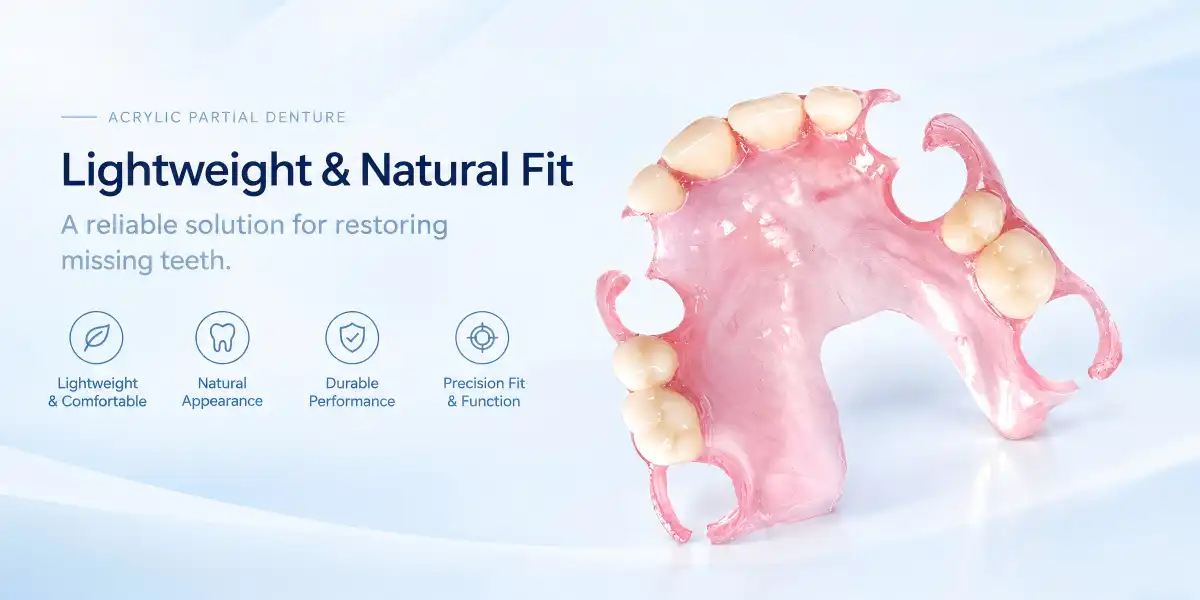
A Complete Acrylic Denture is a detachable device that replaces all of your teeth in one arch, either your upper or lower jaw, or both. The base is made of polymethyl methacrylate (PMMA), a heat-cured resin that gives the structure strength while remaining relatively light. Prosthetic teeth made of acrylic are set into the base to restore the appearance and function of natural teeth.
The prosthesis stays in place because it is in close contact with the mouth mucosa and the remaining ridge below it. It doesn't need to be surgically placed like implant-supported solutions do, so it can be used by a wider range of patients. Initial impressions, final border-molded impressions, jaw relation records, a wax try-in stage for occlusal verification, and final laboratory processing are all parts of the manufacturing process. Chairside fit quality is directly related to how accurately the clinical and laboratory records are captured at each stage.
Benefits of Full-Arch Acrylic Dentures for Labs and Clinics
Dental labs that make or buy full-arch prosthetics made of PMMA have measured operating benefits. These are the main reasons why this type of prosthetic work is important to the creation process:
-
Budget accessibility: Complete Acrylic Dentures are a cost-effective full-arch option, so they can be used by a wide range of patients and can be made in large quantities in a lab.
-
Ease of post-delivery modification: PMMA can be relined, rebased, and repaired in the office without having to be completely rebuilt in the lab. This can reduce patient chair time and lab return cases.
-
Faster fabrication cycle: The acrylic workflow is simpler mechanically than metal framework production, which lets labs with tight schedules have shorter turnaround times.
-
Metal-free design: All-acrylic restorations do not contain a metal framework, which may be considered for patients with documented sensitivity to certain metals, depending on the clinical situation and material specifications.
-
Shock-absorbing occlusal behavior: PMMA has different load-bearing characteristics from porcelain and can provide a degree of shock absorption within the prosthetic system.
Advantages Compared to Alternative Full-Arch Solutions
| Feature | Complete Acrylic Denture | Metal-Based Denture | Implant-Supported Prosthesis |
|---|---|---|---|
| Cost | Low | Moderate | High |
| Fabrication time | Short | Moderate | Long |
| Adjustability | High | Limited | Minimal |
| Surgical requirement | None | None | Yes |
| Weight | Light | Heavier | Variable |
| Long-term durability | Moderate | High | High |
| Patient eligibility | Broad | Moderate | Restricted |
When fast delivery, a wide range of patient eligibility, and the ability to make adjustments in the office are important, acrylic full-arch prosthetics are an option. The acrylic process is suitable for labs that need to source for multiple DSOs or high-volume practices.
Disadvantages to Consider
Clinical trade-offs are a part of every prosthetic solution. When compared to metal frames, PMMA is more susceptible to fracture and can break under excessive dental stress. If acrylic isn't handled properly, residual monomers may irritate sensitive patients' oral tissues. If the prosthesis is made with low-quality materials or processed incorrectly, dimensional changes may also occur.
Over time, jawbone resorption changes the topography of the tissue below, so the denture may need to be relined on a regular basis to maintain fit. People who have strong gag reactions or a documented hypersensitivity to PMMA may require alternative treatment options. For any company being considered, procurement teams should ask for appropriate material documentation and verify that the materials meet applicable regulatory requirements.
Clinical Indications
Complete Acrylic Dentures are recommended for patients who have lost all of their teeth, have teeth that can't be saved, or are in the process of having teeth extracted and healing. They can also be used as temporary or transitional prosthetics while implants are osseointegrating. As temporary fixes while permanent implant restorations are being made, labs that work with implant centers often make acrylic immediates. The PMMA material platform is used for both economy denture lines and interim dentures. This makes the acrylic workflow flexible across a range of clinical service levels.
Materials and Manufacturing Workflow
PMMA Resin and Tooth Selection
The resin base is made of polymethyl methacrylate that has been heat-cured. This type of curing can provide a controlled polymerization process compared with cold-cured varieties. To fit the patient's face and bite, acrylic artificial teeth are chosen based on shade, shape, and occlusal plan. Labs that sell to the U.S. market must use materials that meet applicable regulatory requirements.
Production Process Steps
The steps in the manufacturing process are casting an impression, articulating the master cast, setting up a wax denture, evaluating the wax try-in, investing in flasks, removing the wax, packing and pressing, heat curing under controlled pressure cycles, deflasking, finishing, polishing, and checking the quality one last time. The temperature rise, pressure, and length of the curing cycle all have a direct effect on the amount of residual monomer and the accuracy of the dimensions.
Quality Control Checkpoints
Some important things to look for during a check are a strong margin seal, an accurate occlusal plane, making sure the teeth are in the right place compared to the prescription, a good surface finish, and consistent color. Labs that use ISO 13485:2016 quality management systems perform logged checks at every step, which creates records that can be used to support compliance with applicable requirements.
Cost Factors in Procurement
Outsourced Complete Acrylic Dentures are priced based on the type of material used, how difficult they are to make, how much customization is needed, how much it costs to comply with regulations, and the number of orders. Material grade and documentation can affect production costs. It takes longer to handle shade classification, unique occlusal schemes, and bilateral balance changes. The cost of quality management, regulatory compliance, and applicable certifications may also be reflected in the price per unit from manufacturers who follow the relevant requirements. For DSOs and high-volume labs, volume agreements usually open up tiered pricing systems.
How to Choose a Complete Acrylic Denture Supplier
To find a trustworthy Complete Acrylic Denture maker, you need to look at a number of important factors. Regulatory paperwork such as FDA registration or listing information where applicable, CE-related documentation where applicable, and ISO 13485:2016 certification should be up-to-date and easy to verify. The ability to track the materials used to make PMMA and acrylic teeth helps demonstrate appropriate material documentation and supports quality control.
The ability to produce things is just as important. A provider with clear data on first-time fit accuracy, a history of low remake rates, and a range of turnaround choices, including immediate dispatch, is truly clinically valuable. Warranty terms show the manufacturer's stated after-sales support. If a manufacturer offers free reproduction within a certain warranty window, it lowers the buying lab's financial risk. Clear case tracking and quick communication keep schedules predictable for accounts with a lot of work.
Maintenance and Service Life
A well-made Complete Acrylic Denture may last several years before it needs to be replaced, depending on patient use, oral conditions, material quality, and maintenance. However, every 2 to 3 years, relining or rebasing may be needed because the shape of the remaining ridge changes. Labs should let patients know that they need to take off their prostheses every night so that the tissue can rest and oral hygiene can be maintained. Brushing your dentures every day with a gentle cleaner and soaking them according to the manufacturer's recommendations will help keep the surface in good condition. Patients should not drop their prostheses on hard surfaces because PMMA can fracture when subjected to impact.
Conclusion
Complete Acrylic Dentures continue to be a widely used and accessible full-arch prosthetic option for dental labs and clinics. Buying choices depend on how well the materials are matched, how precisely they are made, and how reliable the suppliers are. When labs work with qualified, experienced makers to get their supplies, they get a stable supply chain, less risk of having to remake things, and the ability to turn things around quickly. Any supplier that wants to be seriously considered for a procurement conversation should have materials that meet regulatory requirements, well-documented quality systems, and quick customer service after the sale.
FAQ
How long does a complete acrylic denture last?
A full-arch acrylic prosthesis that is well taken care of can last for several years. Both bone loss and material wear affect how long something lasts. To maintain the fit, relining or rebasing may be needed as the residual ridge changes.
Is a complete acrylic denture the same as an economy denture?
The same PMMA technology is often used to make economy denture lines. Material grade and tooth quality can change from tier to tier, which affects how long they last and how they look.
Can an acrylic partial denture be a permanent solution?
As short-term fixes, acrylic base partial dentures can be used in appropriate cases. Long-term use is possible, but the structure needs to be checked regularly because it may not provide the same mechanical performance as a cast metal framework.
What certifications should a supplier hold?
For labs that sell to people in the U.S. and Europe, buyers should verify the supplier's applicable regulatory registration or listing information, CE-related documentation where applicable, and ISO 13485:2016 certification where claimed. The specific requirements depend on the product and target market.
What causes poor fit in acrylic full-arch dentures?
Fit discrepancies are usually caused by inaccurate impressions, incorrect records of vertical dimensions, errors in jaw relation records, tooth arrangement, processing, or insufficient quality control.
Can patients sleep with acrylic dentures?
Patients are generally advised to remove removable dentures overnight so that the oral tissues can rest and to support appropriate oral hygiene. Specific instructions should follow the clinician's recommendations.
What is the typical production turnaround?
For removable prosthetics, standard production takes between 4 and 5 business days. For urgent clinical deadlines, there are options for faster production.
Are PMMA dentures biocompatible?
Heat-cured PMMA is widely used for denture bases. Proper processing is important because residual monomer may affect oral tissue tolerance. Material selection and processing should follow the applicable product requirements and manufacturer's instructions.
What is a complete acrylic denture made of?
A complete acrylic denture typically consists of a denture base made from PMMA resin and artificial teeth made from dental acrylic or other denture tooth materials. The exact materials depend on the product specification and laboratory workflow.
How is a complete acrylic denture made?
A complete acrylic denture is typically produced through a series of laboratory steps, including impression processing, master cast preparation, jaw relation records, tooth arrangement, wax try-in, flasking, wax removal, acrylic packing, heat curing, deflasking, finishing, polishing, and final quality inspection.
What is the difference between a complete acrylic denture and an implant-supported denture?
A complete acrylic denture is removable and is supported primarily by the oral tissues and residual ridge. An implant-supported prosthesis uses dental implants for additional support and retention and requires surgical implant placement.
What is the difference between a complete denture and a partial denture?
A complete denture replaces all teeth in an arch, while a partial denture replaces some missing teeth when natural teeth remain. Complete acrylic dentures are commonly used for fully edentulous arches.
Are complete acrylic dentures removable?
Yes. Complete acrylic dentures are removable prostheses. Patients can remove them for cleaning and follow the clinician's instructions for daily and overnight use.
Can complete acrylic dentures be repaired or relined?
Yes. Depending on the condition of the prosthesis, acrylic dentures may be repaired, relined, or rebased. The appropriate procedure depends on the type of damage, the condition of the denture, and the patient's oral condition.
What information does a dental lab need to order a complete acrylic denture?
A dental lab generally needs the patient's impressions or digital records, jaw relation information, prescribed tooth shade and mould, occlusal requirements, and any special clinical or design instructions. Exact requirements depend on the case and laboratory workflow.
What should dental labs check when sourcing complete acrylic dentures from overseas?
Dental labs should check the supplier's company information, applicable regulatory documentation, material specifications, quality management system, production workflow, turnaround time, shipping arrangements, warranty terms, communication process, and remake policy.
How can dental labs reduce remake rates for complete acrylic dentures?
Dental labs can help reduce remake rates by providing accurate impressions or digital records, clear prescriptions, correct jaw relation information, appropriate tooth selection, complete case instructions, and by working with suppliers that maintain documented quality-control procedures.
Is a complete acrylic denture suitable for immediate dentures?
Acrylic materials are commonly used for immediate dentures. The final fit may change as the extraction sites and residual tissues heal, so follow-up adjustment, relining, or replacement may be required.
What affects the cost of a complete acrylic denture?
The cost depends on material selection, tooth type, case complexity, customization requirements, occlusal scheme, production workflow, order volume, turnaround requirements, and shipping. Dental laboratories should request a case-specific quotation from the supplier.
How long does it take to manufacture a complete acrylic denture?
Manufacturing time depends on the case design, laboratory workflow, quality-control procedures, and shipping method. HYC's standard turnaround time for applicable removable prosthetic orders is 4–5 business days, while expedited production may be available for urgent cases.
Can a dental laboratory outsource complete acrylic denture production?
Yes. Dental laboratories and dental practices can outsource complete acrylic denture production to qualified dental laboratory suppliers. Before outsourcing, buyers should evaluate the supplier's quality system, material documentation, production capacity, turnaround time, shipping process, warranty terms, and communication.
What should I look for in a complete acrylic denture manufacturer?
A dental laboratory should evaluate manufacturing experience, material documentation, CAD/CAM or conventional production capabilities where applicable, quality-control procedures, regulatory information, turnaround time, warranty terms, remake support, communication, and shipping reliability.
Partner With HYC for Reliable Complete Acrylic Denture Supply
HYC has been making dental products for 22 years and brings that experience to every case. We use appropriately documented materials and provide Complete Acrylic Dentures for dental laboratories and dental practices. HYC follows an ISO 13485:2016 quality management system and provides applicable regulatory and material documentation according to product and market requirements. We offer standard turnaround times of 4–5 days and expedited delivery options to help you stick to your production schedule. Every applicable case comes with a one-year guarantee that covers repairs for free. To get a price, email us at info@hycdentallab.com or go to hycdentallab.com.
References
1. American College of Prosthodontists. Edentulism and Tooth Loss in the United States. Journal of Prosthodontics, 2019.
2. Zarb, G.A., Hobkirk, J., Eckert, S., & Jacob, R. Prosthodontic Treatment for Edentulous Patients. Elsevier Mosby, 2013.
3. Phoenix, R.D., Cagna, D.R., & DeFreest, C.F. Stewart's Clinical Removable Partial Prosthodontics. Quintessence Publishing, 2008.
4. Anusavice, K.J., Shen, C., & Rawls, H.R. Phillips' Science of Dental Materials. Elsevier Saunders, 2013.
5. International Organization for Standardization. ISO 20795-1: Dentistry — Base Polymers — Part 1: Denture Base Polymers. ISO, 2013.
6. U.S. Food and Drug Administration. Guidance for Dental Device Submissions: Polymethyl Methacrylate Denture Base Materials. FDA Center for Devices and Radiological Health, 2020.
YOU MAY LIKE