Acrylic Base Partial Denture Procurement for Removable Prosthetic Cases
Sourcing an acrylic base partial denture for removable prosthetic cases requires balancing fit precision, material properties, turnaround speed, customization, and regulatory requirements. Acrylic partial dentures are widely used for replacing one or more missing teeth and can serve as interim or longer-term removable prosthetic solutions depending on the clinical situation. For B2B dental procurement, buyers should evaluate suppliers based on material documentation, quality management systems, customization capability, quality control, turnaround time, and reliable logistics before establishing a long-term partnership.
Introduction
Removable prosthetics remain an important category in restorative dentistry. Dental clinics, group practices, and dental laboratories regularly use Acrylic Base Partial Dentures to address a wide range of patient needs, from replacing a single missing tooth after extraction to providing interim removable restorations before implant or fixed treatment.
The Acrylic Base Partial Denture is different from other removable partial denture options. It uses an acrylic resin base and can be designed for a variety of clinical situations. It is also relatively straightforward to fabricate, adjust, repair, and modify compared with some other removable prosthetic designs. For clinics, DSOs, and dental laboratories that manage removable prosthetic cases, access to consistent, well-fitting Acrylic Base Partial Dentures can offer practical procurement benefits.
What Is an Acrylic Base Partial Denture?
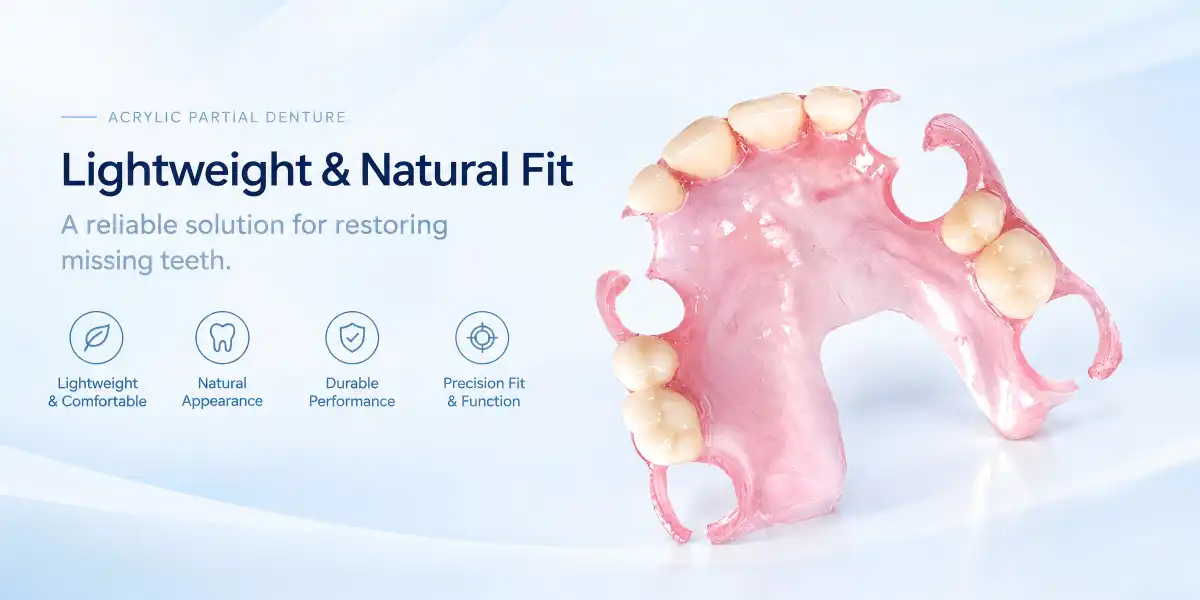
An Acrylic Base Partial Denture is a removable dental prosthesis that uses an acrylic resin base and artificial teeth to replace one or more missing teeth. The acrylic base rests on the oral tissues and provides the primary tissue support, while wire clasps or other retention components may be incorporated according to the case design.
Compared with cast metal partial dentures, acrylic partial dentures rely more heavily on the denture base and oral tissues for support. This design can make the prosthesis relatively simple to fabricate and modify.
Acrylic Base Partial Dentures can be used for immediate tooth replacement after extraction and may also be used as longer-term removable prosthetic solutions in selected cases where implants or fixed bridges are not suitable or are not part of the treatment plan.
Benefits of Acrylic Partial Dentures
Acrylic Base Partial Dentures are commonly considered by dental professionals and procurement teams for several practical reasons:
Lower production cost can help clinics and dental laboratories manage a wider range of cases.
Rapid fabrication turnaround can support treatment schedules where a removable prosthesis is needed within a short period.
Easy chairside adjustment can make minor modifications more straightforward.
Lightweight design can provide a comfortable removable option for many patients.
Modifiable and repairable — additional teeth can be added, and the acrylic base can be relined or repaired when clinically appropriate.
Because of these characteristics, Acrylic Base Partial Dentures remain a practical option for removable prosthetic workflows and selected interim or longer-term cases.
Advantages Over Alternative Removable Solutions
When comparing removable prosthetic options, Acrylic Base Partial Dentures have different fabrication and maintenance characteristics from cast metal and flexible partial dentures.
The fabrication process is generally less dependent on metal framework casting, which can simplify the production workflow. This may be useful for dental laboratories and clinics managing a high volume of removable prosthetic cases.
Polymethyl methacrylate (PMMA) is a widely used material for denture bases. Research has evaluated PMMA denture base materials in relation to mechanical properties, surface characteristics, microbial adhesion, and cleaning methods.
One practical advantage of an acrylic base is its ability to be modified in appropriate cases. Acrylic partial dentures can often be repaired or relined, and additional teeth may be added when the existing design and clinical situation allow.
Disadvantages to Consider Before Procurement
In B2B dental procurement, it is important to understand both the advantages and limitations of each removable prosthetic material. Acrylic Base Partial Dentures have several factors that buyers, doctors, and dental laboratories should consider.
Denture base surfaces can accumulate plaque and microorganisms if the prosthesis is not cleaned properly. Research has shown that PMMA denture base materials can support microbial adhesion and biofilm formation, making appropriate cleaning and maintenance important considerations.
Acrylic does not provide the same rigidity and fracture resistance as a cast metal framework. Depending on the case design and occlusal conditions, acrylic components may be susceptible to fracture if subjected to excessive forces or accidental impact.
Another clinical consideration is residual ridge change. As the oral tissues and residual ridge change over time, the fit of a removable partial denture can change as well. Clinical evaluation, adjustment, relining, rebasing, or replacement may therefore be required depending on the patient's condition.
Comparison: Acrylic vs. Metal vs. Flexible Partials
Understanding the differences between these three prosthetic options helps procurement teams select an appropriate solution for each patient and practice.
| Feature | Acrylic Base Partial | Cast Metal Partial | Flexible (Nylon) Partial |
|---|---|---|---|
| Cost | Low | Medium to High | Medium |
| Turnaround Time | Fast | Moderate | Moderate |
| Fracture Resistance | Moderate | High | High |
| Repairable/Relineable | Yes | Limited | Limited |
| Tissue Support | Primary | Tooth + Tissue | Tissue |
| Best Use Case | Interim or budget cases | High-stress, long-term | Aesthetic/metal-free cases |
| Regulatory Documentation | Material and device documentation required | Material and device documentation required | Material and device documentation required |
Maintaining relationships with suppliers that can provide different removable prosthetic options can be operationally efficient for clinics and dental laboratories that manage a wide range of cases.
Clinical Indications
Acrylic Base Partial Dentures may be used across a range of clinical scenarios:
Post-extraction immediate replacement for patients who need temporary tooth replacement while healing before implant or bridge treatment.
Kennedy Class I–IV partial edentulism where tissue-borne support is clinically acceptable.
Interim prosthetics during implant treatment and healing.
Economy removable prosthetic cases where the patient needs partial or extensive tooth replacement.
Selected cases where a non-metallic removable appliance is preferred or clinically appropriate.
The final prosthetic design should always be determined according to the patient's oral condition, treatment plan, and professional clinical judgment.
Materials Used in Acrylic Partial Fabrication
Heat-Cured PMMA Resin
Heat-cured polymethyl methacrylate is a commonly used denture base material. When processed according to the manufacturer's requirements, PMMA can provide appropriate dimensional stability, surface finish, and bonding characteristics for removable prosthetic applications. PMMA denture base materials are also covered by established dental material standards and regulatory considerations.
Acrylic Denture Teeth
Prefabricated acrylic or composite resin teeth are selected according to shade, shape, and size to achieve an appropriate appearance and occlusal arrangement. Tooth material and selection can affect appearance, wear resistance, and long-term color stability.
Wire Clasp Components
Stainless steel or cobalt-chromium wire clasps may be incorporated when additional retention is required. The clasp size, shape, position, and design should be selected according to the anatomy and requirements of the individual case.
Manufacturing Workflow
Making an Acrylic Base Partial Denture that fits well follows a controlled fabrication process that can affect initial fit, function, and the need for subsequent adjustments.
The process starts with scanning an impression or pouring a model. Next comes occlusal registration and articulation. The technicians then arrange the selected denture teeth on a wax base, shape the base according to the patient's oral anatomy, and proceed to flask investment. Once the wax is removed, heat-cured PMMA is packed and polymerized under controlled temperature and pressure conditions. After curing, the denture is deflasked, trimmed, and polished in several steps. Before final shipment, quality control checks the base structure, occlusal contacts, tooth arrangement, and overall fit.
Cost Factors in Acrylic Partial Procurement
When buying Acrylic Base Partial Dentures in bulk, prices depend on several factors:
Number of teeth being replaced and Kennedy classification complexity.
Tooth shade and mold selection, with higher costs for premium brands.
Wire clasp count and design — additional clasps may require additional fabrication time.
Relining or rebasing requirements on existing cases.
Shipping method — regular shipping vs. fast or flash delivery.
Order volume — higher case volumes may qualify for tiered pricing.
How to Choose a Reliable Supplier
To choose a reliable Acrylic Base Partial Denture supplier, buyers should evaluate several important factors. Regulatory documentation and quality management are important starting points. Suppliers should be able to provide appropriate product and material documentation and demonstrate applicable quality management practices, such as ISO 13485:2016 certification where applicable.
In addition to compliance, buyers should evaluate customization capability. A professional dental laboratory should be able to follow case-specific shade, mold, tooth arrangement, clasp, and design instructions rather than relying only on generic templates.
Turnaround time should also be clearly communicated before production. Buyers should understand standard production times as well as the available options for urgent or expedited cases.
Support after the sale is another important consideration. Clear warranty terms, repair or remake procedures, and responsive case communication can help dental laboratories and clinics manage outsourced removable prosthetic cases more efficiently.
Maintenance Recommendations
To support the service life and hygiene of removable prosthetics, patients should follow the care instructions provided by their dental professional and the laboratory:
Remove the partial denture as directed to allow proper cleaning and oral tissue rest.
Clean the denture with a soft brush and an appropriate non-abrasive denture cleanser. Avoid abrasive toothpaste, which can scratch acrylic surfaces.
Store the denture according to the manufacturer's care instructions when it is not being worn.
Schedule periodic clinical evaluations to check fit as the residual ridge and oral tissues change over time.
Consider relining, rebasing, adjustment, repair, or replacement when clinically indicated.
Key Takeaways
Acrylic Base Partial Dentures are a widely used type of removable prosthetic. They offer a practical combination of affordability, customization, repairability, and relatively straightforward fabrication. When sourcing these restorations, clinics and dental laboratories should consider initial fit accuracy, material documentation, quality management, quality control, turnaround time, customization capability, and supplier support.
For clinics and laboratories that manage a high volume of removable prosthetic cases, working with a consistent dental laboratory supplier can help streamline case communication, production, shipping, and after-sales support.
FAQ
What is an acrylic base partial denture?
An acrylic base partial denture is a removable dental prosthesis made with an acrylic resin base and artificial teeth to replace one or more missing teeth. The acrylic base rests on the oral tissues and provides primary support, while retention components such as wire clasps may be used according to the case design.
What material is used for an acrylic partial denture?
Acrylic partial denture bases are commonly fabricated from polymethyl methacrylate (PMMA) resin. Artificial teeth may be made from acrylic or composite resin, while stainless steel or cobalt-chromium components may be used for retention when required.
When is an acrylic partial denture used?
An acrylic partial denture may be used for immediate post-extraction tooth replacement, interim prosthetic treatment, selected partial edentulism cases, and other situations where a removable prosthesis is clinically appropriate.
Is an acrylic partial denture removable?
Yes. An acrylic partial denture is designed to be removed for cleaning, maintenance, adjustment, and periodic clinical evaluation.
Are acrylic partial dentures suitable for temporary use?
Yes. Acrylic partial dentures are commonly used as interim removable prostheses, including cases where patients are waiting for healing, implant treatment, or another definitive restoration.
Can an acrylic partial denture be used as a long-term prosthesis?
Yes, in selected cases. An acrylic partial denture may be used as a longer-term removable prosthesis when the design, fit, oral condition, and maintenance requirements are appropriate. Regular professional evaluation is important because the residual ridge and oral tissues can change over time.
How long does an acrylic partial denture typically last?
There is no single service-life period that applies to every acrylic partial denture. Longevity depends on the material, design, fit, occlusal forces, oral condition, hygiene, maintenance, and handling. Repair, relining, rebasing, adjustment, or replacement may become necessary as the prosthesis and oral tissues change.
Can acrylic partial dentures be repaired?
Yes. Depending on the type and extent of damage, acrylic partial dentures can often be repaired, relined, rebased, or modified. Additional teeth may also be added in suitable cases.
Can additional teeth be added to an acrylic partial denture?
In many cases, yes. Additional teeth can be added when the existing design, available space, denture base condition, and clinical requirements allow the modification.
What is the difference between an acrylic partial denture and a cast metal partial denture?
An acrylic partial denture primarily uses an acrylic base for tissue support, while a cast metal partial denture uses a rigid metal framework designed to provide support and retention through the remaining teeth and oral tissues. The two options differ in rigidity, fabrication methods, repairability, and clinical indications.
What is the difference between an acrylic partial denture and a flexible partial denture?
An acrylic partial denture uses an acrylic resin base and can generally be repaired or relined more readily. A flexible partial denture typically uses a flexible thermoplastic material and may be selected when a metal-free appearance is desired. Material properties, retention, repairability, and clinical indications differ between the two options.
Is PMMA suitable for denture bases?
PMMA is a widely used denture base material with established applications in removable prosthodontics. Research has evaluated conventional and CAD/CAM PMMA materials for mechanical and surface properties. The suitability of a particular PMMA material depends on the product, fabrication method, intended use, and applicable requirements.
How should an acrylic partial denture be cleaned?
An acrylic partial denture should be cleaned regularly with a soft brush and an appropriate non-abrasive denture cleanser. Abrasive toothpaste should generally be avoided because it can scratch acrylic surfaces. The prosthesis should also be removed as directed by the dental professional for proper cleaning and tissue rest.
Does an acrylic partial denture need to be relined?
An acrylic partial denture may need to be relined when changes in the residual ridge or oral tissues cause the fit to deteriorate. The timing varies between patients and should be determined through professional evaluation.
What should dental laboratories look for when sourcing acrylic partial dentures?
Dental laboratories should evaluate the supplier's material documentation, quality management system, customization capability, production workflow, quality control, turnaround time, packaging, shipping reliability, warranty terms, and after-sales support.
Can a dental laboratory outsource acrylic partial denture cases?
Yes. Dental laboratories may outsource acrylic partial denture fabrication when they need additional production capacity or specialized removable prosthetic support. Case-specific prescriptions, design requirements, material information, and applicable regulatory documentation should be confirmed before production.
What information should be provided when ordering an acrylic partial denture?
A complete order should generally include the required case information, missing-tooth information, tooth shade and mold selection, tooth arrangement requirements, clasp or retention requirements, occlusal information, and other design instructions required for fabrication. The exact information required depends on the case and the laboratory's workflow.
How can dental laboratories choose an acrylic partial denture supplier?
Dental laboratories should compare suppliers based on case quality, communication, customization capability, material documentation, production consistency, turnaround time, shipping reliability, repair or remake policies, and long-term B2B support rather than evaluating price alone.
What is important when outsourcing acrylic partial denture cases?
Clear prescriptions, accurate case information, consistent communication, documented materials, defined turnaround times, quality control, and clear repair or remake procedures are important when outsourcing acrylic partial denture cases. These factors can help reduce avoidable communication issues and improve workflow consistency.
Partner With HYC for Precision Acrylic Base Partial Denture Supply
Every removable prosthetic case that HYC makes is backed by 22 years of experience making dental restorations. Our company is a reliable source for Acrylic Base Partial Dentures. We offer fully customized production, documented PMMA materials, ISO 13485:2016 compliance, and a 1-year guarantee that covers free repair or replacement. You can get your cases back to you in 4–5 days or faster with our flash delivery choices. To get a price, email us at info@hycdentallab.com or go to hycdentallab.com.
References
Teixeira, A. B. V., de Carvalho, G. G., & Dos Reis, A. C. "Surface Characteristics and Microbial Adhesion in Polymethylmethacrylate for Denture Base Submitted to Antimicrobial Agents and Cleaning Agents: A Systematic Review." European Journal of Prosthodontics and Restorative Dentistry, 2023.
"Incorporation of antimicrobial agents in denture base resin: A systematic review." Journal of Prosthetic Dentistry, 2020.
Limírio, J. P. J. O., et al. "Mechanical properties of polymethyl methacrylate as a denture base: Conventional versus CAD-CAM resin - A systematic review and meta-analysis of in vitro studies." Journal of Prosthetic Dentistry, 2022.
U.S. Food and Drug Administration. "Denture Base Resins - Performance Criteria for Safety and Performance Based Pathway." 2022.
U.S. Food and Drug Administration. "Recognized Consensus Standards: ISO 20795-1 Dentistry - Base polymers - Part 1: Denture base polymers."
European Commission. "Custom-made devices." Medical Devices.
YOU MAY LIKE
 Full Cast Crowns.webp "Noble (Semi-Precious) Full Cast Crowns")