Dental Implant Crowns: Use Screw-Retained or Cement?
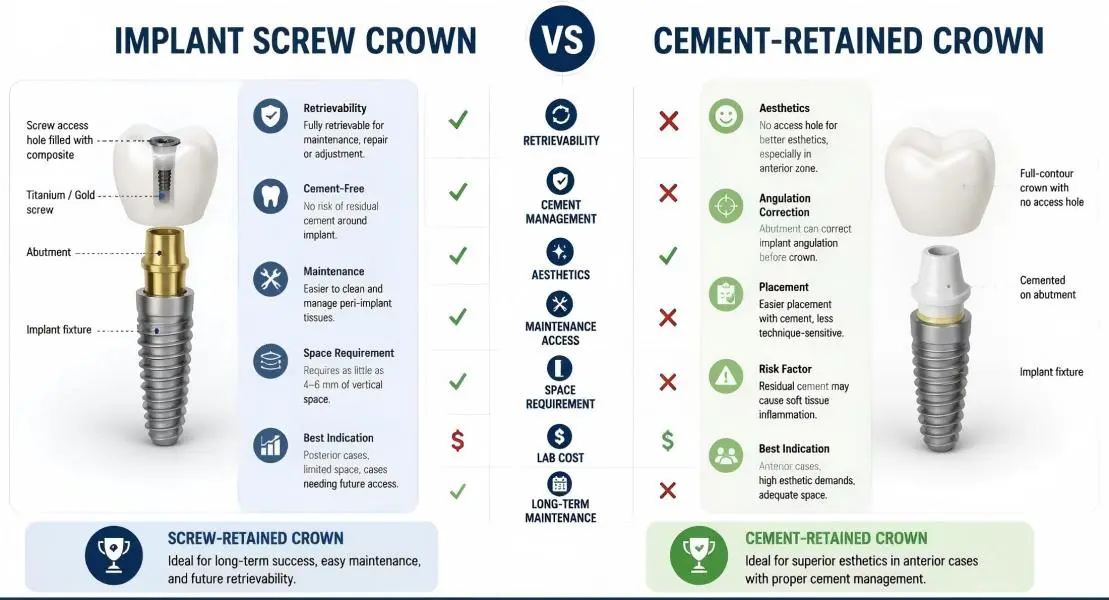
When restoring dental implants, clinicians face a fundamental choice: screw-retained or cemented crowns. The answer depends on your clinical scenario, patient anatomy, and long-term maintenance expectations. An Implant Screw Crown avoids the need for excess cement removal and provides predictable retrievability for maintenance and future adjustments. This design secures the prosthetic restoration directly to the implant fixture using titanium or gold screws, making it a valuable option when future adjustments or repairs are expected. Cemented crowns require careful cement management, as residual cement may increase the risk of soft tissue inflammation around implants.
Understanding Dental Implant Crowns: Screw-Retained vs Cement
The choice of implant retention method can influence clinical workflow, maintenance requirements, patient satisfaction, and overall treatment planning. Screw-retained and cemented restorations are used for different things, and knowing how they are designed helps buying workers choose products that meet the needs of the business.
What Is a Screw-Retained Implant Crown?
Implant replacements that are held in place by titanium or gold artificial screws attach porcelain-fused-to-metal or solid zirconia crowns directly to the implant body or abutment. The repair has a small access hole in the occlusal or lingual area. This lets the screw go through the crown and connect with the implant platform's internal threads. For safety reasons, the access channel is blocked with composite resin or PTFE tape covered in opaque composite after the screw is tightened to the manufacturer's specs, which are usually 15 to 35 Ncm. This hides the metal screw head.
This design prioritizes retrievability and eliminates the need for cement retention during restoration placement. The whole repair can be taken off, looked at, cleaned, or changed without hurting the implant or bone underneath. Biocompatibility is still very high because materials like titanium and zirconia are widely used materials with established biocompatibility characteristics. When regular screw tightening and skilled upkeep are done, long-term clinical performance can be excellent when proper treatment planning and maintenance protocols are followed.
What Is a Cemented Implant Crown?
Unlike an Implant Screw Crown, for cemented crowns to work, a different abutment, which can be pre-made or custom-milled, must be permanently attached to the implant hardware. After that, resin-modified glass ionomer or resin cements are used to attach the crown to the support. This two-step process makes a passive fit and smooth gingival curves, which is especially helpful in the cosmetic zone where screw access holes would look bad.
The primary advantage lies in aesthetic simplicity: no obvious access holes, and the crown design can imitate the way natural teeth appear without any gaps. It's also easier for cemented fillings to work with implant angulation issues because the base can be changed to fix the problem before the crown is put on. But too much cement stuck under the gums is still a problem, and it's been linked to more cases of peri-implantitis and inflammation of soft tissues.
Core Advantages and Limitations
Screw-retained caps are great when maintenance access and cement-free delivery are priorities. Clinicians can fix nail loosening, cracks, or occlusal changes with retrievability without having to replace the whole restoration. Because cement is not required around the implant collar, this design may simplify hygiene management and reduce concerns associated with residual cement. This design may simplify hygiene management around the implant restoration. As little as 4 to 6 mm of vertical room is needed for these restorations, making them suitable for posterior cases or situations with limited restorative space.
In anterior cases where aesthetics are a primary consideration, cement-retained crowns may be considered depending on the clinical situation. The absence of a screw access hole may provide aesthetic advantages in selected anterior cases. It's easy to place, so it doesn't take as much technical skill to torque. However, one limitation is that removal may require crown modification or replacement depending on the clinical situation when you need to make fixes or changes. Even in the hands of professionals, residual cement may contribute to soft tissue irritation if not completely removed.
Procurement professionals have to compare these trade-offs with how the clinic works and the types of patients it sees. Screw-retained solutions work best for high-volume practices that treat complex cases, while cement-retained options may be considered in highly aesthetic anterior cases, as long as strict rules are followed for removing the cement.
Critical Comparison for Decision Making: Screw-Retained vs Cement Crowns
The choice of retention method is affected by cost factors, clinical success measures, and the patient experience. Dental labs, buying managers, and implant experts can improve inventory tactics and case planning by understanding these factors.
Lifespan and Maintenance Protocols
When taken care of properly, screw-retained repairs demonstrate exceptional durability. The replacement screw may need to be retightened every three to five years. This is a simple process that can be done in minutes without any pain. Crown materials, especially monolithic zirconia, demonstrate excellent strength and fracture resistance in many clinical applications. Because they are retrievable, broken porcelain veneers can be fixed outside the mouth without having to replace the whole treatment. This may help reduce additional clinical procedures in selected cases.
When they are done perfectly, cemented crowns also last a long time. However, the Implant Screw Crown offers a different approach. But because repair workers can't get to the abutment-implant link, it's open to attack. Over time, cement-related complications may occur if excess cement remains or if maintenance challenges develop. To fix a cemented crown, it usually has to be taken off by cutting through the crown, which means a new replacement has to be made. This makes it more likely that treatments will need to be redone and takes longer, which hurts both the clinic's efficiency and the patients' happiness.
Patient Comfort and Recovery
As the final crown is put on months after implant surgery, both holding methods work well during osseointegration. When screw-retained crowns are put in, Screw-retained restorations can simplify the delivery process because they do not require cement application. Screw-retained restorations avoid cement-related cleanup procedures during delivery, which can simplify the clinical workflow.
Crowns that are cemented in place may temporarily become sensitive if too much cement bothers the gum tissue. To remove cement properly, you need to be very careful and check the results with X-rays, which adds time to your chair time. Patients with thin biotypes or swollen gingiva may take longer to heal if cement dust is not removed.
Pricing Structures and Customization
Precision engineering is needed for the Implant Screw Crown, which is why they usually cost more in the lab. Accurate screw channels, anti-rotation features, and access hole design all need advanced CAD/CAM milling. But deals to buy in bulk and regular work processes can help cover these costs. Customization is still easy because the crown design is based on digital scans, so no separate joint manufacturing is needed.
At first glance, cemented crowns may seem cheaper, especially if you use stock abutments. Still, custom abutments, which greatly enhance gum health and result in better looks, cost about the same as screw-retained options. When you think about the cost of replacements, problems with cement, and not being able to do simple fixes, screw-retained systems may provide advantages in long-term maintenance and serviceability depending on clinical requirements.
Aligning Selection with Clinical Context
Screw-retained options are better for posterior implants that don't have a lot of vertical room because they need less restorative height and are easier to maintain in the future. In front cases, where screw access holes would show up on the face, it can be hard to keep the teeth looking natural. To avoid this, custom abutments with lingual set-screws or cement-retained crowns are used. Today's CAD/CAM technology lets labs make angled screw channel technology, which can expand treatment options in selected aesthetic cases. This moves the entry holes to the lingual or palatal surface, which increases the range of cosmetic procedures that can be done with screws.
Procurement Insights: Where and How to Source Implant Screw Crowns
To find high-quality screw-retained repairs, you need to carefully evaluate suppliers, make sure they follow the rules, and coordinate procedures. Dental labs, clinic buying managers, and wholesalers all have to find a good mix between quality, speed of turnaround, and low cost.
Leading Supplier Profiles and Quality Certifications
Nobel Biocare, Straumann, and Zimmer Biomet are well-known companies that make complete implant systems with their own screw-retained crown options. These businesses follow strict quality standards, such as being ISO 13485:2016 certified, FDA registered, and CE compliant. Their product lines include a variety of link types and materials, such as titanium, zirconia, and porcelain joined to metal. This makes sure that their products work with a wide range of implant platforms.
Independent labs and mid-level providers often have prices that are competitive and meet international biocompatibility standards. Check that the partners you're thinking about have FDA-listed materials, proof of third-party testing, and tracking procedures. A trustworthy seller keeps records of batches, material certificates, and the ability to do radiological checks to make sure that quality is maintained across all production runs.
Ordering Flexibility and Turnaround Times
Organizations that provide a lot of dental services need scalable ordering systems that can be expanded to handle both large purchases and changes for a single unit. Leading suppliers have digital case filing tools that let doctors post scans, choose the materials they want, and keep an eye on real-time production milestones. Screw-retained crowns usually take three to five days to get, but there are faster choices for cases that need to be done quickly.
When treatment times are short because of an emergency, flash delivery services can get the medicine to you the next day. Purchasing teams should make deals with vendors that spell out the level of service expected, such as how to handle emergency orders, how to make sure shipments are insured, and how to handle remakes. Smaller practices can get high-quality screw-retained options without having to spend too much on inventory because the minimum order numbers are flexible.
Logistics Management and Delivery Reliability
Dental replacements, including Implant Screw Crown, are time-sensitive, high-value products that need to be shipped safely and with tracking. Reliable sellers work with transport services that know how to handle medical devices that are easily broken. To keep things from getting damaged during shipping, packaging should have cases that can withstand pressure, moisture shields, and seals that can't be broken.
Supply chain openness is important. Vendors who offer shipment tracking, delivery proof, and proactive contact make clinics less stressed and help them make more accurate case plans. When buying from other countries, make sure that the shipping methods you choose are legal in the country where the goods will be delivered.
Evaluating Supplier Reputation and After-Sales Support
Reliability in a supplier goes beyond the quality of the products they sell and includes quick responses to customer questions, helpful expert advice, and warranty security. A good vendor partnership includes easy access to expert support for case planning questions, help choosing materials, and troubleshooting tips for when fit problems happen. The warranty terms should make it clear how long the coverage lasts (usually two years for screw-retained crowns) and what conditions apply to free repairs or replacements.
Peer reviews, industry certifications, and case study files can all be used to judge a company's image in the market. Long-term trust is earned by suppliers who consistently meet requirements, have low remake rates, and communicate clearly. This lowers buying risk and improves business stability.
Maintenance and Long-Term Performance of Implant Screw Crowns
Maximizing the functional lifespan of screw-retained restorations requires organized care procedures, patient education, and proactive monitoring. Clinics implementing these strategies report higher patient satisfaction and reduced long-term costs.
Routine Cleaning and Periodic Check-Ups
Professional care is easier with screw-retained crowns because the repair can be removed for cleanings. Clinicians take the crown off, clean the implant platform and the inside of the crown, look for tiny cracks or porcelain breaks, and then put the screw back in place according to the instructions. This process only takes a few minutes and lets you see the tissues around the implant directly, which may help clinicians monitor peri-implant tissues more effectively.
Around implant sites, patients should use Implant Screw Crown, toothpaste that doesn't abrade the teeth, and soft-bristle brushes. Water flossers or interdental brushes can be used in addition to get rid of plaque under the crown borders. Professional cleanings every six months keep bacteria under control and check the strength of the screws.
Managing Screw Loosening and Crown Adjustments
Sometimes screws come free because of masticatory forces or not enough initial torque. Some signs are slight movement, popping sounds, or pain when chewing. If the problem is found early, retightening the screw fixes it without any other work being done. If the diagnosis is delayed, the screw or joint may break or become damaged, which will require more complicated fixes.
Screw-retained features make it easy to make changes to the occlusal plane. The crown can be taken out, fixed on the bench, and then put back in without having to make a new repair. This gives you more options, which cuts down on chair time and protects the original repair investment.
Patient Recovery Strategies and Education
Long-term results are better when people are taught how to clean their implants properly. Clinics should give written care directions that stress how important it is to get regular checkups, brush at the right angle, and avoid using too much horizontal force. Patients like the retrievability feature because they know that upkeep or fixes can be done without causing too much damage.
Most of the time, recovery goes smoothly after an Implant Screw Crown delivery. Patients can go back to normal right away, and they don't have to watch what they eat other than avoiding things that are too hard in the first few weeks. The absence of cement may reduce concerns related to residual cement sensitivity in selected cases.
Troubleshooting Compared to Traditional Crowns
When problems happen with traditional fixed crowns, it can be hard to figure out what's wrong. Radiographs may show bone loss or pieces of cement, but to fix these problems, the crown has to be cut off, which is a damaging and expensive process. With screw-retained fillings, you can fix problems without hurting the tooth: just remove, look, clean, and put it back in. This feature turns complicated issues into normal upkeep jobs, which keeps the healing process going and the doctor-patient relationship strong.
Future Trends and Innovations in Implant Screw Crowns
Technological advancements and evolving market demands are reshaping screw-retained Implant Screw Crown design, materials, and production workflows. By keeping up with these trends, procurement teams can use new ideas that improve both speed and patient results.
Material Innovations and Aesthetic Advancements
Next-generation zirconia versions have better strength and translucency, making them look like real teeth while still being stable enough for screw-retained designs. Layered zirconia systems have a strong heart and a thin layer of porcelain on top that makes the tooth look good. Manufacturers are making solid composite systems that cover screw access holes, using dual-cure materials that don't change color or chip over time.
By mixing ceramic structures with resin polymers, hybrid materials make it harder for things to break while also lowering the stress at the point where the implant meets the bone. The tensile strength of these materials is between 150 and 350 MPa, and their modulus of elasticity is very close to that of natural dentin, minimizing biomechanical complications.
Digital Transformation and CAD/CAM Workflows
Labs can now use advanced CAD software to create screw channels that are at an angle, which lets them move access holes up to 25 degrees from where they were originally located. This new idea makes screw-retained crowns more useful in cosmetic areas by moving the holes to the palatal or tongue sides. Three-dimensional printing lets you make quick prototypes of custom abutments and surgery guides, which makes implant placement more accurate and cuts down on the time needed for adjustments at the chairside.
Cloud-based case management systems make it easy for hospitals and labs to talk to each other about Implant Screw Crown cases. This lets people review designs, change materials, and keep track of production all in real time. These digital environments shorten response times and cut down on communication mistakes, which makes the supply chain work better overall.
Market Drivers and Demand Shifts
As more people learn about the benefits of dental implants, the need for long-lasting, low-maintenance options grows. Screw-retained crowns are in line with this trend because they are easy to remove and have a lower risk of complications. As populations age, people keep their natural teeth for longer, which increases the need for personalized replacements that can fit a wide range of body shapes.
Concerns about the environment are affecting how clinics buy things. They prefer sellers who use eco-friendly packaging, cut down on waste by precise milling, and set up recycling programs for metal parts. More attention is being paid by regulators to biocompatibility tests and proof of traceability, pushing manufacturers toward higher transparency and stricter quality controls.
Strategic Recommendations for Procurement Teams
To build flexible supply relationships, you need to look at partners on a number of factors, including their technical skills, ability to follow regulations, dependability in logistics, and investment in new ideas. Set up deals with recommended vendors that cover things like training, case consultation, and access to new technologies. Diversify your source groups to lower your risk and keep quality standards high.
Spend money to teach your staff about screw-retained crown signs, material qualities, and how to take care of them. Teams with more knowledge make better choices about case planning, lower the number of remakes, and better explain value propositions to dentists who suggest patients. Professionals in buying stay up to date on changes in technology and the competition by reading trade magazines, going to trade shows, and taking part in classes put on by manufacturers.
Conclusion
Implant Screw Crowns offer predictable retrievability and may simplify maintenance procedures in selected cases. This makes them perfect for back replacements and cases that will need entry in the future. For better looks in the front, cemented caps are better, but screw-retained options are growing by using curved screw holes and better materials to make them more useful. Buyers should look at a supplier's quality standards, how quickly they can turn orders around, and how well they help customers after the sale. Putting money into screw-retained technology is in line with market trends that want stable, low-complication restorations that make patients happier and improve business efficiency.
FAQ
How do I handle a misaligned implant that would put the hole through the front of the tooth?
With today's CAD/CAM technology, labs can make curved screw tracks that move the entry hole up to 25 degrees away from the front of the tooth and toward the back. This method keeps the look of things without affecting their functional strength. If the angle is more than 25 degrees, you should suggest either a custom abutment with a tongue set-screw or switching to a cement-retained crown over a custom abutment. Both options keep the natural look while adjusting for differences in implant placement.
How do I prevent the screw-access hole from chipping or looking dark?
To get rid of gray shadows, suggest replacements made of zirconia instead of porcelain attached to metal. Tell the lab to round the inside edges of the access hole while it is still "green." This will keep stress from building up and causing chipping. Cover the screw head with PTFE tape, then cover the metal with dual-cure opaque composite. Finally, add an aesthetic composite layer that matches the color of the crown. This multi-layer method creates long-lasting, color-stable access hole fillers that don't change color or break.
Partner with HYC for Precision Implant Screw Crown Solutions
When it comes to making screw-retained implant crowns that meet the strictest clinical and legal standards, HYC has 22 years of experience. Our production facilities operate under ISO 13485:2016 quality management standards, with applicable FDA registration and CE compliance for relevant products. They use dental materials that comply with applicable regulatory requirements and material standards to support consistent quality, biocompatibility, and reliable clinical performance. As a reliable Implant Screw Crown manufacturer, we offer customized solutions designed to meet individual case requirements. Standard cases are typically completed within 3–5 working days depending on case complexity and requirements. When you need to act quickly, expedited shipping options may be available for urgent cases. For two years, we provide warranty coverage for manufacturing-related issues according to our warranty policy. Our quality control processes are designed to support consistent fit accuracy, reliable outcomes, and efficient clinical workflows. Get in touch with us at info@hycdentallab.com to talk about your case and experience a reliable workflow supported by consistent quality and communication.
References
1. Sailer, I., Karasan, D., Todorovic, A., Ligoutsikou, M., & Pjetursson, B. E. (2022). Prosthetic failures in dental implant therapy: A systematic review. Journal of Dental Research, 101(9), 1039-1050.
2. Wilson, T. G., Valderrama, P., Burbano, M., Blansett, J., Levine, R., Kessler, H., & Rodrigues, D. C. (2019). Foreign bodies associated with peri-implantitis human biopsies. Journal of Periodontology, 90(11), 1368-1375.
3. Wittneben, J. G., Buser, D., Salvi, G. E., Bürgin, W., Hicklin, S., & Brägger, U. (2014). Complication and failure rates with implant-supported fixed dental prostheses and single crowns: A 10-year retrospective study. Clinical Implant Dentistry and Related Research, 16(3), 356-364.
4. Chee, W., & Jivraj, S. (2007). Screw versus cemented implant-supported restorations. British Dental Journal, 202(9), 501-507.
5. Michalakis, K. X., Hirayama, H., & Garefis, P. D. (2003). Cement-retained versus screw-retained implant restorations: A critical review. International Journal of Oral & Maxillofacial Implants, 18(5), 719-728.
6. Weber, H. P., Kim, D. M., Ng, M. W., Hwang, J. W., & Fiorellini, J. P. (2006). Peri-implant soft-tissue health surrounding cement- and screw-retained implant restorations: A multi-center, 3-year prospective study. Clinical Oral Implants Research, 17(4), 375-379.
YOU MAY LIKE
.webp "Ni-Cr PFM (Nickel-Chrome)")