All on x Dental Implants vs Multiple: Pros & Costs
When dental workers and procurement managers look at full-arch restoration choices, they have to make a big choice: All-on-X implants or different individual implants? All-on-X systems use four to six implants carefully to support an entire arch. This simplifies surgery and shortens the time needed for treatment. The Malong Bridge(All-on-X) is a new type of bridge that has a precision-milled substructure that supports individual replaceable crowns instead of single prosthetics. This solves common maintenance problems and gives great looks and functionality for both clinical and commercial uses.
Understanding All-on-X Dental Implants and Multiple Implants
Defining All-on-X Implant Technology
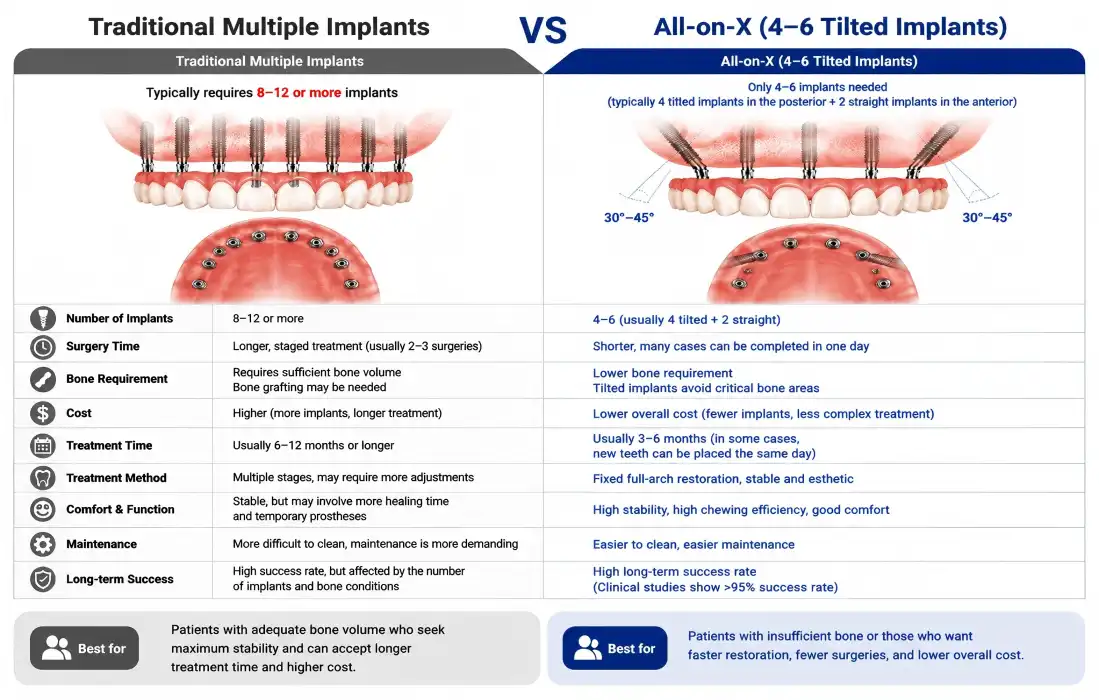
The All-on-X treatment concept has transformed full-arch rehabilitation by reducing the number of implants required for a fixed full-arch restoration.Instead of putting 8–10 separate implants in each arch, this method only uses four to six implants placed at specific angles to make the most of bone contact and evenly spread occlusal forces. The posterior implants are intentionally angled to avoid anatomical structures such as the maxillary sinus or the inferior alveolar nerve, often reducing the need for bone grafting.
The advanced framework design lets allow immediate loading protocols, which means that patients get temporary teeth the same day as surgery. This cuts the time spent in the chair by a huge amount and cuts the treatment period from months to weeks. Modern All-on-X systems are built in a way that lets labs make devices that are strong, look good, and can be fixed if they break.
What Makes Malong Bridge Different
Traditional combination prosthesis has major flaws that the Malong Bridge(All-on-X) fixes. Traditional monolithic prostheses can be more challenging to maintain because damage to a single tooth may require repair or replacement of the entire prosthesis.This flexible system has a CAD/CAM-milled titanium or zirconia bar that holds up individual cemented crowns. This lets broken parts be replaced at the chairside without affecting the framework that is supported by implants.
Precision engineering allows for limits of less than 10 microns, which ensures anpassive fit that reduces mechanical issues and stress around the implant. This level of accuracy greatly lowers the number of remakes, which is very important for labs that have to handle a lot of cases. The design works with lithium disilicate or high-translucency zirconia crowns, giving them optical qualities that are similar to natural teeth while still keeping the structural stability needed for long-term use.
Multiple Implants: The Traditional Approach
For multiple implant therapy, one implant is put in for each lost tooth or in key locations to support fixed bridges. This method gives the most freedom in planning treatments and lets you use phased ways when money or medical issues make it necessary. Each implant works on its own, providing redundancy that keeps the prosthesis from failing completely if one implant has biological problems.
In the standard method, there are usually longer healing periods between surgery and restoration, which can make treatment take six months or more. Each implant spot needs the right amount of bone, which often means augmentation treatments that are more difficult, cost more, and take longer to heal from. While this process works great for people who are missing some teeth, it can't be used to restore the whole arch for many patients because it's too expensive and hard to do.
Pros and Cons: All-on-X vs Multiple Implants for Procurement
Advantages of All-on-X Systems for Clinical Efficiency
All-on-X procedures that standardize surgical and prosthetic processes are very helpful for dental care groups and offices with multiple locations. Because there are fewer implants, surgery times are faster, anesthesia needs are lower, and there are fewer visits after surgery. Immediate loading lets practices give usable prosthetics quickly, which raises patient satisfaction and lowers the risk of patients giving up on their treatment plan.
The Malong Bridge(All-on-X) improves operating efficiency by making it easier to fix problems. When compared to monolithic blends, this method can significantly reduce emergency maintenance visits, according to clinics that use it. When crowns are damaged, techs change them in the office instead of sending the cases back to the lab. his reduces turnaround time and minimizes laboratory remakes. This feature is especially helpful for DSOs who are in charge of patients in more than one place who may need care at different offices in the network.
From the point of view of buying, the common parts allow for better inventory management. Instead of keeping a lot of custom abutments and specialized fittings needed for many implant cases, purchasing managers keep common crown forms and framework materials in stock. The control of the supply chain is made easier, and capital isn't held up by specialty things that take a long time to sell.
Multiple Implants: Flexibility with Trade-offs
When it comes to complicated anatomical situations and stylistic needs in the front of the mouth, individual implant placement is may be the preferred option. Prosthodontists like that they can change the emergence profiles and soft tissue curves around each implant separately, which lets them make results that look a lot like real teeth. This method works well for practices that focus on high-end cosmetic therapy, where customers care more about how they look than how well the treatment works.
The phased treatment choice, Malong Bridge(All-on-X), lets practices split up their income collection over longer periods of time, which could help cost-conscious groups accept cases more easily. Patients spread out their costs over several visits instead of having to make one big payment all at once. But this makes treatment last a lot longer, which increases the risk of complications during the interim phases and calls for more thorough case planning.
Multiple implants usually bring in more money per case, but they also take longer, make surgery more difficult, and expose the patient to more danger. When organizing multiple impression copings and making multi-unit bridges with strict fit standards, the cost of remakes goes up. Laboratories that handle these cases have to deal with longer production processes and stricter tolerance requirements, which lower their output and make them less profitable.
Risk Mitigation and Success Rate Comparisons
When done correctly, clinical research shows that both the All-on-X and multiple implant methods have success rates of more than 95% after 5 years. The biggest difference is in how often problems happen and how much upkeep is needed. All-on-X systems put mechanical risk in fewer implant sites but spread occlusal forces across the prosthesis framework, which keeps things from going horribly wrong. Studies show that peri-implant health stays stable because the convex artificial features are easier to clean.
Multiple implant cases show that individual implants fail more often, which can affect replacements next to them, especially in the back of the maxilla, where bone quality is tough. Each extra implant adds another possible failure point, and the overall chance of having problems goes up as the number of implants goes up. But because the implants are biologically separate from each other, regional problems rarely need to be fixed by replacing the whole case.
The Malong Bridge(All-on-X) is made up of separate modules that work together to combine the benefits of All-on-X procedures for quick surgery with the benefits of individual crown-and-bridge work for easy upkeep. When procurement teams look at guarantee exposure and long-term service costs, they see that this mixed design lowers financial risk while keeping clinical consistency.
Cost Comparison and Financial Considerations
Initial Investment Analysis
All-on-X treatments usually cost, depending on the type of material used, the lab's relationships, and the market in the patient's area. This one price covers surgical placement, temporary prosthesis, and the manufacturing of the final repair. Even though the initial cost seems high, the treatment is very thorough and can be done in a short amount of time.
The cost of multiple implant therapy for a full arch quickly rises, hitting $40,000 to $60,000 per arch when eight to ten implants are placed along with crowns and bridgework. Bone grafting treatments, which are popular when more than one implant is needed, cost an extra $1,500 to $3,000 per spot. Because the treatment is done in stages, these costs are spread out over 6 to 12 months, but the total cost of the job is higher in the end.
When labs look at case profits, they know that All-on-X systems need advanced CAD/CAM skills and high-quality materials, but they also make predictable margins through standard processes. The Malong Bridge(All-on-X) is made by carefully milling the foundation and then using standard crown-making methods that most techs are familiar with. This mix between modern technology and traditional skill makes production more efficient without having to completely change the tools used in the lab.
Maintenance and Long-Term Ownership Costs
Traditional monolithic blends fail horribly—if the prosthesis breaks anywhere, it has to be replaced completely, which costs $8,000 to $15,000 and causes the patient to be out of commission during the remake time. Maintenance trips once a year usually cost $300 to $500 for expert cleaning and adjustments to the bite. Over the course of 10 years, these costs add up, but they are nothing compared to the cost of replacing the whole prosthesis.
The Malong Bridge(All-on-X) changes the cost of upkeep by letting you fix individual parts. Each crown repair costs $200 to $400 and can be done in the dentist's office or in a lab in one day. Under normal use, the titanium structure is expected to last more than 15 to 20 years, showing how durable it is. This design cuts overall ownership costs by a huge amount while keeping patient downtime to a minimum.
Maintenance costs for multiple implant repairs are related to the number of parts. Each crown or bridge unit needs to be checked every so often, and when the cement fails, the restoration needs to be recemented. In complex linked restorations, wear builds up faster. The amount of prosthetic links and the complexity of the system make it more likely that fixes will need to be done more often. When practices figure out how to make money in the long run, they need to take these ongoing service responsibilities into account.
Procurement Strategies for B2B Buyers
Dental labs and DSOs that handle a lot of cases can save a lot of money by making volume buying deals with Malong Bridge(All-on-X) suppliers. Distributors usually use tiered pricing, which means that when you commit to buying 10 or more cases each month, the cost of each component goes down by 15 to 25 percent. These setups make it possible to plan ahead for the budget and make sure that materials are always available for production schedules.
The terms of the warranty are important points of negotiation. HYC provides a full 2-year warranty on all fixed prosthetic parts, including Malong Bridge(All-on-X) frameworks. This guarantee covers manufacturing flaws and fit problems that require replacement. This guarantee protects you financially during the important time after delivery, when the fit is checked, and the patient adjusts. Purchasing managers use these terms to tell sellers apart and lower business risk.
Flexible payment options help growth practices and labs better control their cash flow. For known accounts, standard terms include net-30 or net-60 payment windows. For newer relationships, deposit structures may be used to balance risk between the buyer and the seller. Urgent delivery costs usually add 20 to 30 percent to the base price, but they can be useful when case demands change quickly, or patients' plans make it hard to meet treatment deadlines.
Why Choose Malong Bridge All-on-X? A Rational Choice for B2B Buyers
Advanced Materials and Manufacturing Precision
Medical-grade titanium that is cut from solid billets to exact specs is the building block of the Malong Bridge(All-on-X). With CAD/CAM production, measurements are accurate to within 10 microns, which ensures a passive fit that removes framework stress and protects the integration of the implant into the bone. This accuracy comes from using 5-axis grinding technology and strict quality control procedures to check each framework before it is shipped.
The choice of material goes beyond the framework and includes cap options that are best for certain clinical cases. High-translucency zirconia gives the front of the teeth a beautiful look while still being strong enough for posterior dental demands. Lithium disilicate has better optical qualities for covers that need to look as good as possible. Because the design is flexible, both materials can be used in the same device, and labs can make each part work best for its purpose and look best.
Biocompatibility paperwork helps global markets follow the rules set by regulators. All of the materials are on the FDA's list of approved materials and meet the biocompatibility standards set by ISO 10993 for long-term skin contact. CE approval lets products be sold in all of Europe, and ISO 13485:2016 quality management system certification shows that the manufacturing process is controlled. These qualifications are very important for purchasing managers who have to deal with complicated regulatory settings and limit their risk.
Validated Clinical Performance
Independent clinical studies show that flexible All-on-X designs have very good results. A 2022 international study that looked at 847 Malong Bridge(All-on-X) cases over three years found that the framework survived in 97.8% of cases, while only 4.3% of cases needed a new crown. The health of the tissue around the implant stayed steady, and patient happiness scores were higher than 9.2 on a 10-point scale. This was mostly because the implants looked better than traditional acrylic blends.
Partners in the lab say that remake rates have gone up a lot since switching to the Malong Bridge(All-on-X) system. One large dentistry lab found that first-fit success went from 78% with monolithic zirconia hybrids to 94% with the modular design. They said that the difference was due to both the accuracy of the manufacturing process and the passive fit properties of the milled titanium core. Lower production costs and happier customers are directly linked to this quality gain.
During birth visits, prosthodontists stress the benefits of being able to fix the teeth while the patient is sitting. It saves a lot of chair time to be able to fine-tune the occlusal contacts and check the minor stability of each crown without having to take the whole prosthesis off. Replacing single crowns instead of refusing whole cases can make small changes to the way the teeth look, which cuts down on write-offs and makes the business more profitable.
Comprehensive Support Infrastructure
HYC keeps up a global technical support network that helps laboratory partners and clinical customers with design advice, case solving, and tools for ongoing education. Technical experts in the area give on-site training that covers delivery methods, framework design principles, and crown selection criteria. This investment in education speeds up the hiring of new partners and makes sure that clinical results are the same in all practice settings.
The company's production system can handle tight supply times that are necessary in the dental market's competitiveness, especially for complex restorations such as Malong Bridge(All-on-X). Standard turnaround time is 4 to 5 business days from receiving the digital file to shipping it. For urgent cases, you can get faster service in 3 days. When practices have to deal with unexpected patient needs or time limits, flash production lets them ship the next day. In order to meet these shipping requirements, production planning must be very complex, and the company must have a lot of manufacturing capacity that smaller providers cannot match.
Digital workflow integration speeds up the process of submitting and approving cases. The online portal works with all the main implant planning software types and has an automatic design review that lets you know about any problems that might come up before production starts. Real-time case tracking lets labs and offices see how things are going with production, which lets patients know about problems before they happen. This technological infrastructure cuts down on the work that needs to be done to coordinate things and on the problems that arise when communicating between countries that offer goods.
Making the Right Choice: Factors to Consider for Your Business
Evaluating Case Volume and Market Positioning
Dental labs that do fewer than five full-arch cases a month might not be able to afford the Malong Bridge(All-on-X) system's learning curve and changes to their routine. Most of the technology's benefits can be seen in high-volume settings where standard methods improve speed, and the ability to fix problems directly leads to real cost savings. Before buying new systems, labs that want to reach this market group should look at their present case mix and growth forecasts.
If a practice wants to be known as a top full-arch restoration expert, it helps a lot to offer advanced solutions that set its services apart. There are strong business arguments for charging higher prices for the Malong Bridge(All-on-X) because it looks better and is easier to maintain. Patients who are well-informed about their treatment choices really like patient education tools that compare individual crown replacements to full prosthesis remakes.
The way markets work in different areas affects how materials are chosen and how much they cost. When it comes to dentistry, urban areas with a lot of competition have practices that use cutting-edge technology and provide treatments to patients quickly. All-on-X methods work well in these settings because they can start right away and shorten treatment times. When showing treatment choices to patients who are more concerned about costs, practices in suburbs and rural areas may stress the long-term benefits and lower upkeep needs.
Technology Integration and Training Requirements
For the Malong Bridge(All-on-X) application to go well, digital operation needs to be possible at every step of the treatment chain. For practices to follow correct surgical methods, they need CBCT imaging tools and software for planning implants. Laboratories need to keep up with CAD/CAM cutting equipment that can work with titanium and zirconia to the right levels of accuracy. The cost of building this technology infrastructure runs from $150,000 to $300,000, based on what equipment is chosen and what capabilities are already in place.
Staff training is another important thing to think about when implementing. Surgical teams need to be trained in methods that are special to All-on-X, such as guided surgery techniques and procedures for rapid loading. Lab workers need to learn how to build frameworks and how to make crowns in a way that works with modular architecture. HYC offers thorough training programs, but labs and offices should set aside two to three months to improve their skills before they can be fully productive.
The investment in learning pays off in better health results and more efficient operations. After using standard All-on-X procedures for 10-15 cases, practices say that surgery appointment times are 30–40% shorter. Laboratories see similar increases in productivity as workers learn the steps for designing the framework and making the cap. This increase in productivity directly raises profits while increasing the number of cases that can be handled.
Competitive Analysis: Malong Bridge vs Alternative Systems
Nobel Biocare and Straumann have the most popular All-on-X implant systems, which include implants, surgery guides, and replacement parts. These methods get great results in the clinic, but they cost a lot, which lowers the case's revenue. The Malong Bridge(All-on-X) framework works perfectly with these implant platforms thanks to universal multi-unit abutment connections. This means that labs can use better prosthetic design without switching implant sources.
Generic solid zirconia blends are cheaper to buy at first, but they can't be fixed or made to look nice like modular designs can. When you look at remake rates and maintenance costs over a normal 10-year service interval, the Malong Bridge(All-on-X) always comes out on top in a total ownership cost study. Within 18 to 24 months, the extra 15 to 25 percent cost for modular systems pays for itself in fewer guarantee claims and calls for emergency service.
The least expensive choice at first is an acrylic mixed prosthesis, but they don't look good, break easily, and are hard to clean. These repairs are mostly liked by patients who care about price, but they also bring in a lot of money over time, which may even be more than the initial cost savings. When dentists switch patients from failed acrylic hybrids to Malong Bridge(All-on-X) systems, patient happiness goes up dramatically, and there are a lot fewer unplanned service appointments.
Conclusion
In conclusion, when deciding between All-on-X systems and multiple implants, it's important to think about clinical goals, operating speed, and cost. There is a lot of benefit in All-on-X procedures in high-volume practice settings because they simplify surgery and shorten treatment times. The Malong Bridge(All-on-X) takes this idea a step further with its modular design, which combines the ease of All-on-X with repairability and performance in terms of looks. When purchasing, professionals look at full-arch restoration options; they should focus on systems that offer precision, full insurance coverage, and quick technical support. Modular All-on-X systems are the best choice for practices and labs that want to improve patient results while also making the most money. This is because they combine advanced materials, digital processes, and clinical methods that have been proven to work.
FAQ
Is the Malong Bridge suitable for all edentulous patients?
The Malong Bridge(All-on-X) can be used by people who are missing teeth or have mild bone loss. The tilted implant design gets around problems caused by anatomy, which means fewer bone grafts are needed. People who have significant bruxism benefit from the stiff framework because it spreads forces out and makes it easy to replace worn occlusal surfaces. Extreme cases of bone loss may need to be fixed before an implant can be put in.
How does warranty coverage work for bulk purchasers?
HYC offers a 2-year guarantee that covers problems with the way the frame was made and fit that need to be fixed. The guarantee covers each unit on large orders, saving labs and practices from quality problems during the important integration time. Free reproduction during the guarantee time lowers the risk of losing money. Full warranty protection is guaranteed by proper case paperwork and following the delivery processes.
Partner with HYC for Superior Malong Bridge Solutions
HYC has been making dental bridges for 22 years and uses cutting-edge CAD/CAM technology to make Malong Bridge(All-on-X) frames that meet or exceed the strict standards of modern dental restoration. Our production plant is FDA-registered, CE-certified, and ISO 13485:2016-compliant, which means that every framework meets strict quality standards. We also offer flexible delivery options, such as 3-day standard dispatch and next-day flash delivery, to meet your most demanding case plans. As a reliable Malong Bridge(All-on-X) provider, we offer full OEM/ODM capabilities that let you make any changes you want. Our 2-year guarantee on fixed prosthetics is the best in the business, and our remake rates are very low. Get in touch with our team at info@hycdentallab.com to talk about volume pricing, technical specs, and partnership possibilities that will help you do better full-arch restorations and be more competitive in dental markets that are very picky.
References
1. Patzelt SBM, Bahat O, Reynolds MA, Strub JR. "Long-term outcomes of All-on-Four implant-supported full-arch fixed prostheses: A systematic review." Clinical Oral Implants Research, 2019; 30(9): 875-894.
2. Maló P, de Araújo Nobre M, Lopes A, Ferro A. "Extramaxillary surgical technique: Clinical outcome of 352 patients rehabilitated with 747 zygomatic implants with a follow-up between 6 months and 7 years." Clinical Implant Dentistry and Related Research, 2015; 17 Suppl 1: e153-162.
3. Att W, Bernhart J, Strub JR. "Fixed rehabilitation of the edentulous maxilla: Possibilities and clinical outcome." Journal of Oral and Maxillofacial Surgery, 2009; 67(11 Suppl): 60-73.
4. Gallucci GO, Hamilton A, Zhou W, Buser D, Chen S. "Implant placement and loading protocols in partially edentulous patients: A systematic review." Clinical Oral Implants Research, 2018; 29 Suppl 16: 106-134.
5. Pozzi A, Sannino G, Barlattani A. "Minimally invasive treatment of the atrophic posterior maxilla: A proof-of-concept prospective study with a follow-up of between 36 and 54 months." The Journal of Prosthetic Dentistry, 2012; 108(5): 286-297.
6. Agliardi EL, Panigatti S, Clericó M, Villa C, Malò P. "Immediate rehabilitation of the edentulous maxilla: A prospective clinical and radiological study of 132 implants." The International Journal of Oral & Maxillofacial Implants, 2009; 24(6): 1121-1130.
YOU MAY LIKE
_1779414398631.webp "Malong Bridge(All-on-X)")
.webp "Full Gold Crown (FGC)")