Full Cast Metal Crown Solutions for Long-Lasting Dental Repairs
When it comes to difficult posterior restorations, like those with heavy occlusal loads, little interocclusal space, or patients who clench their teeth a lot, standard ceramic or zirconia choices don't always work. That's where Full Cast Metal Crown options come in handy. These restorations are recognized for their excellent durability, predictable fit, and long-term clinical performance, making them a reliable option for challenging clinical situations. We at HYC have spent 22 years perfecting the process of making cast metal crowns that meet strict regulatory standards and also work with the real-world pressures you face, such as short lead times, low remake rates, and reliable supply lines that keep your practice running smoothly.
Introduction
Choosing the right restorative option affects more than just the clinical results. It also affects how efficiently you run your business and how happy your patients are. Full Cast Metal Crowns are a tried-and-true way to fix complicated tooth problems, especially in areas that aren't visible and where strength and durability are more important than looks. Some all-ceramic restorations may require specific preparation designs and material selection to achieve optimal performance under high occlusal forces. Metal crowns are highly resistant to chipping and fracture compared with many ceramic alternatives when used in appropriate clinical indications.
From a purchasing point of view, getting these repairs is more complicated than just comparing prices per unit. You're looking at how reliable the seller is, how quickly they can turn things around, and how well they help customers after the sale. When you know about the clinical benefits and how the supply chain works, you can make smart choices that balance quality, cost, and delivery performance. This is especially important when you're in charge of multiple DSOs, high-volume labs, or implant centers with tight case deadlines.
Understanding Full Cast Metal Crowns: Composition, Benefits, and Applications
Material Composition and Alloy Selection
Full Cast Metal Crowns are carefully made from metal alloys, which are divided into three groups based on the amount of precious metal they contain. High-noble alloys generally demonstrate excellent biocompatibility and favorable tissue tolerance. Noble metals are strong and valuable at the same time because they contain both palladium and silver. Base metal alloys, such as cobalt-chromium alloys, provide high strength and cost efficiency for many clinical applications. However, they can't be burnished like high-noble choices can, which means they can't be adjusted at the chairside. Each piece of material meets specific clinical and financial needs, so it can be changed to fit the needs of each patient and the budget.
Core Clinical Benefits and Workflow Integration
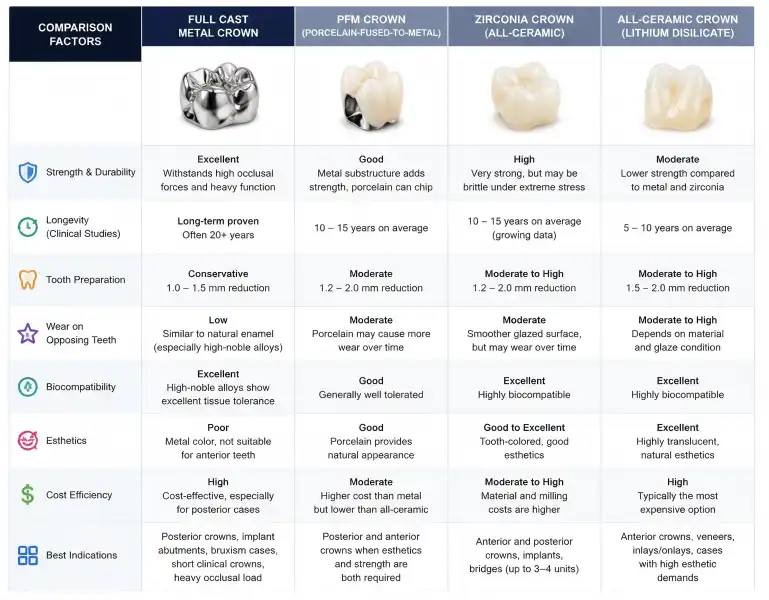
Metal crowns don't need as much tooth preparation as ceramic crowns do—usually only 1.0 to 1.5 mm of buccal reduction is needed. This keeps the healthy tooth structure. This conservative method is very helpful for people who have short clinical crowns or not much leftover dentin. The casting method makes repairs that fit perfectly around the edges, helping achieve precise marginal adaptation and supporting long-term restorative success. High-noble gold metals have a wear rate that is similar to natural enamel. This means that they protect the opposing teeth from too much wear and tear, especially important for people who grind their teeth at night because some ceramic materials may be less suitable for certain high-load situations.
In a clinical setting, the process starts with taking a standard print, then moves on to laboratory casting and cementation. Our facility's customization process makes sure that every repair fits your exact design needs. For more complicated cases that need bridge abutments or implant superstructures, CAD/CAM help is available. With regular brushing and professional cleanings, you can provide long-term service with proper case selection, maintenance, and oral hygiene, which is a lot longer than the 10 to 15 years that porcelain-fused-to-metal options usually last.
Indications and Contraindications
These repairs work really well in some situations where other materials don't. Metal is the strongest material that can be used for abutments for fixed dental implants, posterior molars that have lost a lot of structure due to cavities or cracks, and teeth that have been treated with endodontics and need full coverage. People who have been identified with bruxism or high occlusal forces need restorations that won't break in a very bad way. For example, zirconia has high strength but may behave differently from metal alloys under extreme functional stresses. Metal is easy to work with and can be used to make occlusal plane repairs for teeth that are tilted or supraerupted.
There are times when this isn't a good idea, like when the metal look isn't okay in the front of the mouth, when the patient is allergic to nickel (when base-metal alloys are used), or when simple partial-coverage replacements would be enough. Clinical assessment guides the choice of material based on functional needs versus assumptions for how it looks.
Comparing Full Cast Metal Crowns with Other Crown Types: Informed Decision-Making
Structural Strength and Longevity Analysis
When choosing a crown, knowing how it can fail makes the long-term value clearer. Zirconia crowns break catastrophically, which means that just one crack makes them useless. Full Cast Metal Crowns typically demonstrate predictable wear characteristics, with failures more commonly associated with factors such as cement loss, wear, or changes in supporting structuresthat can be seen and fixed before they get really bad. This big difference has an effect on the total cost of ownership over many years. Porcelain-fused-to-metal crowns look better than full metal crowns, but they need more aggressive tooth reduction and have a higher risk of breaking where the porcelain meets the metal. All-ceramic choices are clearer, but Material selection should be based on occlusal conditions, esthetic requirements, and clinical indications.
Cost-Effectiveness and Budget Considerations
Base-metal cast crowns are the most cost-effective way to fix back teeth in the long run. Even though high-noble gold models cost more to make, their longer lifespan and lower rate of remakes make up for the extra cost. Zirconia's mid-range prices look good at first, but then you realize that it needs to be replaced more often because of fit problems or breaks, and the margins can't be adjusted while the patient is sitting. When purchasing managers compare unit price to lifetime value, many practices may find that metal crowns offer favorable long-term value depending on case requirements and workflow considerations. This is especially true for high-volume DSOs that need predictable results and few chair time changes.
Decision Matrix for Material Selection
There are a number of important things to consider when choosing between materials. For places that people can see, ceramic or zirconia is best, while metal is best for parts that are further back. The amount of room between the teeth becomes very important. Tight bites require metal because ceramics need to be at least a certain thickness to keep them from breaking. Alloy choice is affected by things like bruxism, allergies, and wear patterns on opposite teeth. Instead of using one-size-fits-all methods, procurement teams should build ties with suppliers that offer a range of materials. This way, they can optimize each situation individually.
Procurement Insights and Cost Analysis for Full Cast Metal Crowns
Understanding Pricing Components
Costs per unit are affected by more than just the cost of raw materials. Lab fees depend on how complicated the customization is. For example, simple single crowns cost less than multi-unit bridges that need precise pontic design. Pricing is greatly affected by the alloy choice; high-noble gold commands higher prices, while base-metal cobalt-chromium offers more affordable options. Shipping processes add costs that change based on how quickly you need the goods. This is especially true for foreign purchases. Tiered pricing is often unlocked by making a volume promise, which makes bulk sales appealing for DSOs that handle hundreds of cases every month. When you know about these parts, you can use them to negotiate for better prices without losing quality.
Supplier Evaluation and Vendor Management
Traditional dentistry labs offer individual service, but they might not be able to do rapid scaling. Online sites are convenient, but they need to be carefully checked to make sure they follow the rules and provide consistent quality. When looking at suppliers, make sure that all of their materials are registered with the FDA, that their production methods are certified by ISO 13485:2016, and that they have the right paperwork for CE marking for foreign markets. Time commitments for turnaround are very important. We offer efficient production timelines and flexible delivery solutions to support different case requirements. takes care of routine cases, while our flash delivery options handle real situations with expedited delivery options may be available for urgent cases. Customer service that is quick to respond, especially for case changes or technical questions, is what sets trustworthy partners apart from transactional providers.
Strategies for Cost Optimization
Bidding alone is not enough to get good repairs at good prices. You need to use a strategy as well. Set up a framework that deals with your chosen suppliers to lock in prices for 12 months while still allowing for changes in case volume. To get volume savings, order in bulk for case types that you know will happen, like standard Full Cast Metal Crowns versus special implant abutments. Before placing a big order, ask for samples of new material variations to make sure the fit is correct and the finish is good. Learn about the insurance payment plans in your area and make sure that the materials you choose are in line with the coverage policies. This will help patients pay as little out of pocket as possible, which could delay their acceptance for treatment.
Trusted Brands and Leading Suppliers of Full Cast Metal Crowns for B2B Clients
Supplier Certification and Quality Benchmarks
Leading makers set themselves apart by strictly following international standards. FDA registration supports regulatory compliance requirements for applicable markets, and CE certification makes sure that they follow European rules, which is important for wholesalers who serve more than one market. Getting ISO 13485:2016 approval shows that you have strong quality management systems in place, from finding raw materials to following the rules for the end inspection. Modern technologies for making things, like CAD/CAM design tools and CNC cutting, make it possible to be very precise in a way that is hard to achieve with traditional methods of casting by hand. When looking at possible partners, make sure you ask for proof that these certifications aren't just claims but are actually kept up to date through yearly audits.
Production Capabilities and Technology Integration
Digital processes cut down on response times and improve accuracy in modern dental labs. CAD design tools let you do virtual try-ons before the product is made, which helps you find fit problems early on. helps improve dimensional consistency and manufacturing accuracy., which can't be done by hand. Investment casting in controlled atmospheres reduces the number of holes and other flaws inside the metal. These technological advances directly lead to lower remake rates, which is a key measure for procurement managers who want to keep an eye on how efficiently operations are running. Our center blends 22 years of skilled craftsmanship with cutting-edge technology to make Full Cast Metal Crowns that helps achieve predictable fit and reduce adjustment requirements, reducing the need for chairside changes and patient recalls.
Building Strategic Partnerships
Transactional ties with vendors make the supply chain weak because prices can change, quality can vary, and communication can break down, all of which can slow down work. In strategic relationships, on the other hand, the goals of your suppliers are aligned with your long-term success. Preferred partners will give your urgent cases top priority, keep a backup stock of items that meet your common needs, and let you know ahead of time about production plans. They take the time to learn about your unique needs, such as your preferred margin style, alloy choices, and package formats, so they can give you custom solutions instead of off-the-shelf goods. Our team works together with DSOs and labs to make buying easier, connect to your case management systems, and offer personalized account support that fixes problems before they affect patient care.
Optimizing Long-Lasting Dental Repairs with Full Cast Metal Crown Solutions
Real-World Performance Data
Clinical studies regularly show that metal crowns last longer than other types. Long-term clinical studies have reported favorable survival rates for cast metal restorations, particularly in posterior applications, compared to 85% for PFM and 80% for all-ceramic options. A cost-per-year study shows that metal crowns are the most cost-effective over time, even though they may cost more at first. A study that looked at multiple DSO sites found that high-risk bruxism patients who switched from zirconia crowns to base-metal crowns may help reduce remake rates and chairside adjustment requirements when properly designed and manufactured. When choices about what to buy have a direct effect on profits and patient happiness scores, these results are important.
Integration Best Practices
For Full Cast Metal Crown options to work, the clinical, laboratory, and management teams need to work together. Teach dentists the right way to prepare teeth (1.0 to 1.5 mm occlusal space, chamfer or knife-edge edges, and a 6-degree taper) so that the restorations they make fit correctly. Set up standard ways to take impressions using materials that can catch fine details without distorting them. Set up clear ways for you and your lab partner to talk to each other. Give them thorough shade notes (even for metal) and any special design requests. Use the number of remakes and the time it takes to make changes as KPIs to improve your processes and relationships with suppliers. Our technical support team helps with case planning and fixing problems, so even practices that are switching from all-ceramic standards can have a smooth adoption process.
Emerging Trends and Future Outlook
Digital dentistry keeps changing how restoration work is done. Intraoral scanners are replacing traditional prints, and 3D printers make try-in models. These improvements help make metal crowns better because digital prints get more accurate information about the margins, which cuts down on the number of remakes needed for fit issues. For tough cases, hybrid materials that combine metal substructures with thin ceramic veneers offer better looks without losing strength. People are more interested in reusable noble metal alloys than in single-use clay materials because of sustainability concerns. As a buying worker, you should stay up to date on these changes so that you can adopt new ideas that make things more efficient while still retaining the core benefits—strength, longevity, and biocompatibility—that make cast metal solutions the best choice for difficult posterior restorations.
Conclusion
Full Cast Metal Crowns are still a reliable choice for selected challenging posterior restorations where strength, durability, and reliability are more important than how they look. Their short preparation time protects tooth tissue, and their unbeatable value comes from lasting for decades. For procurement to go well, partners must meet legal requirements, have enough production capacity, be able to turn orders around quickly, and offer responsive support, not just offer reasonable prices. We have 22 years of experience making FDA-registered, CE-certified restorations with the high-precision manufacturing capabilities and consistent quality control processes. This means we can handle even the most difficult case requirements, from simple single crowns to complicated multi-unit implant bridges that need to be delivered quickly.
FAQ
What is the typical lifespan of full cast metal crowns compared to other restoration types?
With proper care, cast metal replacements can last 20–40 years, which is a lot longer than the 10–15 year average for porcelain-fused-to-metal crowns and the 10–12 year average for all-ceramic choices. In clinical research, high-noble gold alloys have the longest recorded survival rates.
Can metal crowns be procured in bulk for multi-location dental practices?
Of course. Tiered pricing, which lowers the cost per unit and makes sure quality is the same everywhere, is possible with volume buying. We help DSOs by offering framework agreements that lock in prices, give each account specialized management, and don't charge minimum order fines for changing monthly case volumes.
How do you ensure regulatory compliance for international markets?
All of the products we use are listed with the FDA, and our factory is ISO 13485:2016 certified and audited every year. Documentation with the CE stamp is sent with packages to European markets to make sure they get through customs and are accepted by regulators. You can get full material safety data sheets and biocompatibility test results if you ask for them.
Partner with HYC for Reliable Full Cast Metal Crown Manufacturing
HYC is ready to become your go-to provider of Full Cast Metal Crown solutions, providing precise restorations that improve your patients' results and the ease of your operations. Our FDA-approved and ISO 13485:2016-certified factory makes crowns completely to your specs using high-noble, noble, and base-metal metals. We know how hard it is for you to meet tight goals, not do anything twice, and stick to budgets that demand the most value. That's why we promise normal shipping in three days, turnaround in four to five days, and flash delivery for real situations. Our restorations are supported by a 2-year warranty covering eligible repair or replacement services that covers free repair or replacement. This protects your investment and the relationship with your patient. Our team gives you the stability you need, whether you're a private practice that wants a very accurate fit or a DSO that needs supply chains that can grow with your business. Get in touch with us at info@hycdentallab.com right away to talk about your needs and experience HYC’s commitment to precision manufacturing, reliable service, and consistent restoration quality.
References
1. Walton JN, Gardner FM, Agar JR. A survey of crown and fixed partial denture failures: length of service and reasons for replacement. Journal of Prosthetic Dentistry, 1986.
2. Schwartz NL, Whitsett LD, Berry TG, Stewart JL. Unserviceable crowns and fixed partial dentures: life-span and causes for loss of serviceability. Journal of the American Dental Association, 1970.
3. Pjetursson BE, Sailer I, Zwahlen M, Hämmerle CH. A systematic review of the survival and complication rates of all-ceramic and metal-ceramic reconstructions after an observation period of at least 3 years. Clinical Oral Implants Research, 2007.
4. Donovan TE, Chee WW. A review of contemporary impression materials and techniques. Dental Clinics of North America, 2004.
5. Rosenstiel SF, Land MF, Fujimoto J. Contemporary Fixed Prosthodontics, 5th Edition. Mosby Elsevier, 2016.
6. Anusavice KJ, Shen C, Rawls HR. Phillips' Science of Dental Materials, 12th Edition. Saunders Elsevier, 2013.
YOU MAY LIKE
 Partial.webp "Cobalt-Chrome (Co-Cr) Partial")