Custom Soft Night Guard Retainer Supports High-Volume Dental Production
Quick Answer
Custom Soft Night Guard Retainers are precision-fabricated intraoral appliances made from flexible, biocompatible thermoplastic materials designed to protect dentition from bruxism and clenching forces. These devices combine clinical effectiveness with high patient compliance, making them essential for dental laboratories and clinics handling substantial case volumes. With proper manufacturing workflows and quality controls, labs can deliver consistent, first-time-fit appliances that reduce remake rates while maintaining rapid turnaround times critical for patient satisfaction and practice profitability.
Introduction
The dental industry faces mounting pressure to deliver protective oral appliances that balance patient comfort with clinical durability. Sleep bruxism affects approximately 8-10% of the adult population, creating consistent demand for protective devices that prevent costly dental damage. Unlike rigid acrylic splints that often sit unused in bathroom drawers due to discomfort, soft night guards have revolutionized patient adherence rates while protecting expensive restorations, natural dentition, and orthodontic investments. This shift has created new opportunities for dental laboratories capable of scaling production without compromising the precision fit that determines clinical success. Understanding the technical specifications, material science, and production workflows behind these devices becomes crucial for procurement managers, lab owners, and clinic operators evaluating manufacturing partners.
What is a Soft Night Guard Retainer?
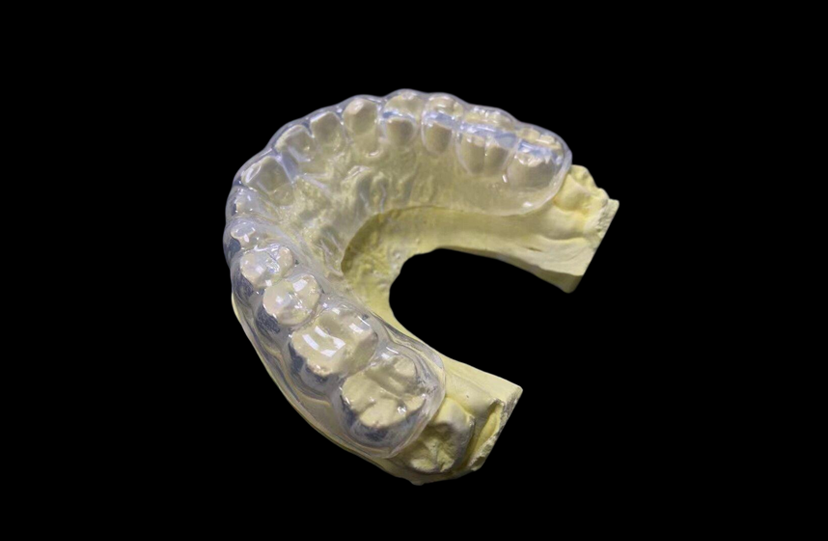
A Soft Night Guard Retainer acts as a soft shield between the upper and lower tooth arches, absorbing and distributing the forces that are created when you grind and clench your teeth at night. The device is made of a single-layer or dual-layer thermoplastic structure that is usually 2.0–3.0 mm thick and is vacuum-formed over a precise tooth model to make a tight fit that won't come loose while you sleep.
Core Design Principles
The safety feature of the appliance depends on the flexibility of the material rather than its rigidity. The thermoplastic polymer briefly changes shape when occlusal forces press down on the soft material. This turns the damaging grinding energy into harmless heat dissipation. This mechanism lowers the amount of harmful forces that reach tooth structures, periodontal ligaments, and temporomandibular joints. It also keeps enough structural memory so that the jaw can return to its original shape after clenching.
Structural Components
Good Soft Night Guard Retainers have edges that are precisely cut to extend 1-2 mm beyond the gum line without touching soft tissues. The palatal or lingual surface stays thick enough to avoid perforation, and the occlusal surface has enough material depth to handle wear over the device's service life, which is usually between six and twelve months for people with normal bruxism.
Benefits of Soft Night Guard Retainers
Adding Soft Night Guard Retainers to your dental services will give you measurable clinical and operational benefits. These perks directly lead to better results for patients and a more efficient practice.
The main medical benefit is that it helps keep enamel healthy. If you don't treat bruxism, the enamel on your teeth wears away permanently, exposing the dentin and making your teeth sensitive. Eventually, the structure of your teeth will become compromised, which will cost a lot to fix. If the soft guard fits properly, it breaks this destructive cycle and protects the tooth structure while the patient works on changing their behavior or dealing with stress.
Patient cooperation rates with soft splints are always higher than those with hard splints. The cushioned feel cuts down on the time it takes to get used to, and the flexible material lets your jaw move naturally without creating pressure points that make you not want to use it at night. Better compliance leads to better protection and fewer emergency appointments for severe TMJ pain or broken restorations.
When it comes to operations, Soft Night Guard Retainers help organize processes that are good for making a lot of things. The thermoforming process works well with digital workflows and can use both standard clay models and 3D-printed versions of them. This adaptability lets labs increase their production while keeping quality high even when handling a lot of cases, which meets the tight response needs of dental service groups with multiple locations.
Advantages Over Alternative Solutions
When compared to rigid acrylic splints, Soft Night Guard Retainers are easier for patients to accept at first. Many people stop using hard splints during the long periods of time they need to be adjusted, which takes away any protective benefit. The soft material quickly molds to the shape of the teeth, getting rid of the uncomfortable feeling of a foreign body that comes with stiff options.
Material Performance Characteristics
Premium Soft Night Guard Retainer materials have Shore A Durometer scores between 60 and 80, which is the best range for protecting against impact and ensuring long-term structural integrity. This range of hardnesses makes sure that the device stays in place and absorbs impact forces well. The hydrophobic polymer mix stops water from absorbing, which stops germs from growing and bad smells from spreading, which shortens the life of the device.
Production Efficiency
Advanced thermoplastic elastomers have great elastic recovery and can keep their shape even after being deformed many times. This "memory" feature makes sure that the guard keeps fitting correctly throughout its useful life, so it doesn't need to be replaced too soon, which would cost patients more money and put a strain on lab production plans.
Technicians spend a lot less time making Soft Night Guard Retainers than they do making hard acrylic splints. Instead of taking hours to finish with acrylic layers, curing, and a lot of different steps, the thermoforming process only takes minutes. Because of this time benefit, labs can handle more cases each day without having to pay their workers more, which increases their profits while keeping their prices affordable.
When Soft Night Guard Retainers are made, quality control procedures become a lot easier. The see-through or clear material lets you check right away for holes, partial adaptation, or contamination. Dimensional verification is quick and easy with simple "try-in" protocols. On the other hand, hard splints often need multiple appointments for adjustments, which is frustrating for patients and makes clinical schedules busier.

Disadvantages and Considerations
To be professional and honest, you have to admit that Soft Night Guard Retainers have some problems. Knowing these limitations lets you set reasonable goals and choose the right cases.
Material durability is the main limitation. Heavy bruxers put more than 200 pounds of force per square inch on the teeth, which can speed up wear or even cause holes in normal 2.0 mm builds. These cases might need 3.0 mm versions that are thicker or replacements more often, which will raise the long-term costs compared to rigid options that can handle rough grinding for years.
Occlusal Repositioning Limitations
While Soft Night Guard Retainers are great for safety, they can't precisely guide the teeth into place like hard stability splints can. Patients who need specific mandibular repositioning to treat TMJ problems may have better results with stiff tools that have carefully changed occlusal schemes. The soft material can't keep its precise vertical dimension or lateral guidance when it's under functional loads, which means it can't be used in complicated TMD treatment plans.
Cleaning and upkeep require patients to be educated and follow the rules all the time. Some thermoplastics are porous, which means they can hold bacteria if patients don't clean them every day. Giving clear care directions is necessary to keep devices from breaking down too soon or causing problems with oral health.
Comparison: Soft vs. Hard vs. Dual-Layer Guards
| Feature | Soft Guard | Hard Acrylic | Dual-Layer |
|---|---|---|---|
| Initial Comfort | Very good | Poor to Fair | good |
| Durability | 6 to 12 months | 2 to 5 years | 1 to 2 years |
| Patient Compliance | 85 to 90% | 45–60% | 70–80% |
| Time of Production | 15 to 30 minutes | 2 to 4 hours | 45 to 90 minutes |
| Rate of Remake | 3-5% | 8–12% | 5-8% |
| Cost per Unit | Low | Medium to High | Medium |
| Suitability | Moderate to mild bruxism | TMD treatment for severe grinders | Mild to serious bruxism |
This comparison shows that Soft Night Guard Retainers work best when patient comfort and production efficiency are more important than maximum durability. Laboratories that work with general dental practices to treat bruxism cases find that Soft Night Guard Retainers are the best way to balance clinical success with operational scalability.
Clinical Indications and Applications
In addition to helping with bruxism, Soft Night Guard Retainers can be used in other clinical situations as well. Realizing these different uses helps labs and clinics get the most out of their devices for all types of patients.
Post-Orthodontic Protection
During the retention phases, patients who are finishing dental treatment are especially at risk. Bruxism can move teeth that have just been straightened, even if they have glued braces on them. As an extra safety measure, a Soft Night Guard Retainer keeps both the orthodontic investment and the holding device itself safe from too much force. The flexibility allows for small settling movements while stopping large displacements.
Restoration Protection
Patients who are spending a lot of money on cosmetic dentistry, veneers, or full-mouth rehabilitation need to be protected for these big purchases. Porcelain and composite materials can handle normal biting forces, but they break when parafunctional loads are concentrated on them. Putting up Soft Night Guard Retainers as soon as the restoration is delivered stops catastrophic failures that hurt patient relationships and make the guarantee invalid.
Athletic and CPAP Compatibility
Because they are thin and flexible, Soft Night Guard Retainers can be used with continuous positive airway pressure therapy to help people with sleep apnea. Rigid splints can make it hard for mask seals to stay in place. Soft Night Guard Retainers, on the other hand, only slightly compress, so they keep airway therapy working and protect your teeth. Some athletes like Soft Night Guard Retainers for daytime clenching protection during training because they are comfortable and let their bodies breathe and stay hydrated.
Materials and Biocompatibility Standards
Material choice has a big impact on how well a gadget works, how safe it is, and how long it lasts. Medical-grade ethylene-vinyl acetate copolymers or thermoplastic polyurethanes are used in high-end Soft Night Guard Retainers to make sure they are biocompatible.
Regulatory Compliance
Materials on the FDA list go through a lot of tests, such as ISO 10993-5 cytotoxicity evaluation and ISO 10993-10 irritation and sensitization studies. These standards make sure that long-term touch across the mucosa doesn't cause any bad tissue reactions, allergic reactions, or systemic toxins. Certificates of biocompatibility from the companies that make the materials are proof that Soft Night Guard Retainers meet the rules for mouth tools.
Manufacturers of good products confirm that their products are free of BPA, phthalates, and latex, which allays patients' worries about hormone disruption and allergic reactions. This clean material description increases the number of qualified patients and lowers the risk of liability for doctors who write prescriptions.
Material Selection Impact
How well a polymer resists tears and how quickly it returns to its original shape are affected by its cross-linking density and the length of its polymer chains. Higher molecular weight distributions make materials more durable under cyclic loads, which means they last longer without losing the soft feel that patients need to be able to comply. Shore hardness testing during the inspection of incoming materials makes sure that production batches are all the same. This keeps the forming characteristics and performance of the finished device predictable.
Manufacturing Workflow for High-Volume Production
Speed and quality control must be balanced in efficient production processes so that labs can meet tight deadlines without having to increase the number of remakes. Knowing about these steps helps sourcing managers choose which manufacturers to work with for their Soft Night Guard Retainer production.
Digital Model Preparation
The process starts with either digitizing the impression or scanning directly inside the mouth. Digital models are virtually trimmed to set the right margins and find undercuts that need to be blocked out. This planning step is very important—not extending the margins enough leads to poor retention, and extending them too far causes tissue irritation and patient pain.
Model Fabrication
3D printing has changed the way Soft Night Guard Retainers are made by making it possible to make models quickly and accurately. Dental stone-colored resins used for printing models show details very well and stay stable at high temperatures during thermoforming. The quality of the finished Soft Night Guard Retainer is directly affected by how smooth the surface is, since any model flaws transfer to the inside of the appliance, creating pressure points and making it less comfortable.
Thermoforming Process
The ready thermoplastic sheet is heated to its transition temperature, which is usually between 70°C and 80°C, until it can be draped properly. The weakened material is pulled evenly over the model's surface by vacuum pressure, making it fit perfectly to all the features of the body. The final fit quality is affected by the amount of pressure, how long it lasts, and how fast it cools. Rapid cooling causes internal forces that make the dimensions unstable.
Trimming and Finishing
Skilled technicians cut away extra material by following anatomical landmarks that were found when the model was being prepared. Smooth, rounded edges keep tissues from getting irritated while still retaining enough material. Edge polishing gets rid of sharp edges, and a final check makes sure there are no gaps, bubbles, or missing pieces that could make the gadget less useful.
Quality Verification Steps
Dimensional accuracy tests show that the finished Soft Night Guard Retainer matches digital specifications within 0.05 mm of what is considered acceptable. Multiple measurements of the material's thickness show that it provides enough protection without being too bulky. A visual review of the transparency shows any internal flaws, and testing of retention on the master model makes sure that the fit is secure enough for normal jaw movements.
Cost Factors in Soft Night Guard Retainer Production
Understanding what factors affect prices helps dentistry clinics and labs set reasonable budget goals and deal well with manufacturing partners for Soft Night Guard Retainer cases.
Material costs are only a small part of the total cost of production, usually making up 15-20% of the total. The cost of premium biocompatible thermoplastics is higher than the cost of common materials, but the investment pays off in better performance and lower remake rates, which more than justify the marginal cost increase.
Labor and Equipment Investment
The biggest cost variable is the time of a skilled expert. Efficient labs plan their work so that each case is handled as quickly as possible. This is called an economy of scale, and it means that as the number of cases goes up, the cost per unit goes down. High-quality vacuum forming machines, 3D printers, and cutting tools are examples of capital equipment that needs a big initial investment but pays for itself over thousands of cases, lowering the cost of additional Soft Night Guard Retainer production.
The level of customization affects how prices are set. Base prices are based on standard single-arch Soft Night Guard Retainers that follow standard protocols. Cases that need special thickness variations, two-layer construction, or room for unusual anatomical features cost more because they take more time and special materials to make.
Volume and Logistics Considerations
The number of items ordered has a big effect on the unit price. When a manufacturing partner offers high-volume production, they usually set prices in tiers, with big savings for steady monthly case amounts. Because they can combine orders, these economies of scale help dentistry service networks and lab networks.
Shipping arrangements affect the total cost of delivery, especially for dental work that needs to be provided quickly because of a deadline. Reliable makers stick to regular production schedules, which lets normal ground shipping work for most cases. Express options are only used in real situations, so you shouldn't have to use them all the time because of production delays.
How to Choose a Reliable Manufacturing Partner
Your lab or clinic's ability to provide consistent quality, meet patient expectations, and stay profitable depends on how well you choose the Soft Night Guard Retainer supplier. This choice is based on a number of important rating factors.
Manufacturing Capability Assessment
Make sure that any potential partners have enough dedicated production capacity to handle the number of cases you expect without creating bottlenecks during times of high demand. When you can, visit factories and pay attention to how the work is organized, how the machines are maintained, and how quality control is done. A high-volume capability doesn't mean much if quality drops when there is a lot of pressure to make Soft Night Guard Retainers.
Regulatory Compliance Documentation
Ask for copies of the ISO 13485:2016 certification that shows how the quality management system is being used in medical device manufacturing. Make sure that facilities that serve the U.S. market are registered with the FDA and that facilities that sell in Europe are marked with the CE mark. Material safety documentation, such as biocompatibility test reports, should be easy to find and not require a lot of follow-up requests.
Communication and Technical Support
Check how attentive the company is during the initial stages of inquiries. Manufacturers that ignore potential customers rarely get better after getting contracts. Make sure that the people who work as technical support have actually worked in a dental lab and not just in customer service. In some complex cases, people need to work together to solve problems, which is why skilled technical help is so important for successful Soft Night Guard Retainer delivery.
Customization Flexibility
Standard protocols work well in most situations, but sometimes they need to be changed. Check to see if potential partners can meet special requests like non-standard thickness, tinted materials for better visibility, or constructions with two arches. Rigid makers who don't let you customize Soft Night Guard Retainers limit your practical options.
Warranty and Remake Policies
Manufacturers who make their warranty terms clear show that they have faith in their quality systems. Look for rules that are clear about what counts as manufacturing flaws and what counts as clinical changes, as well as easy ways to get warranty replacements. Remake rates are an objective way to measure quality. Rates stay below 5% for reputable manufacturers thanks to good quality control.
Maintenance and Patient Education
Proper patient maintenance protocols are very important for making sure that Soft Night Guard Retainers last as long as possible and keep working well. Giving clear directions improves results and lowers the cost of replacing things too soon.
Patients should rinse their Soft Night Guard Retainers with cool water as soon as they take them off in the morning. This will get rid of any spit proteins that have built up before they dry out and harden. Using effervescent retainer tablets for a deep clean once a week gets rid of bacterial biofilms and stops bad smells from developing. Hot water should not be used because temperatures above 60°C set off the thermoplastic qualities, which distort the dimensions and make it impossible to get a good fit.
Storage Recommendations
Proper storage in containers with air holes lets items dry completely between uses, stopping the growth of bacteria that are caused by moisture. Instead of making sealed spaces that are good for microbe growth, enclosed boxes should have holes in them for airflow. Patients shouldn't leave their Soft Night Guard Retainers in full sunlight or near heat sources, like car seats, where the temperature is too high for the material.
Service Life Expectations
Regular inspection helps find patterns of wear that mean replacement is needed. Patients should check their Soft Night Guard Retainers once a month for areas that are getting thinner, holes, or a loss of stretchy recovery, which are all signs of material wear. To keep soft tissues from getting hurt, rough or sharp edges that form during use need to be smoothed by a professional.
Most of the time, good Soft Night Guard Retainers keep working well for six to twelve months with normal use. For severe bruxers, a new one might be needed every four to six months, but for light grinders, it might last longer than a year. Setting realistic replacement intervals during the first delivery keeps patients from being disappointed and makes sure they are always safe.
Key Takeaways
Custom Soft Night Guard Retainers are an important part of modern dentistry because they help with the common problem of sleep bruxism by making devices that are comfortable and acceptable to patients. When compared to hard acrylic options, the thermoplastic construction is much more flexible and effective at protecting because it absorbs force instead of being rigid. Manufacturing efficiency allows for high-volume production, which helps labs make money while keeping the precise fit that is key to clinical success.
Biocompatibility of the materials, optimization of the production process, and strict quality control are what set professional-grade Soft Night Guard Retainers apart from cheaper options. When dental labs and clinics look for manufacturing partners, they should put quality metrics that are easy to understand, regulatory compliance, and demonstrated high-volume capability ahead of price alone. When you compare the operational problems and unhappy patients that come from high remake rates, the small difference in cost between good and great suppliers doesn't matter much.
Knowing about things like cost, upkeep needs, and medical uses helps you make smart decisions about what to buy and which cases to send. Soft Night Guard Retainers work best for mild to moderate bruxism because they put the patient's comfort and initial acceptance first. However, serious grinders or complex TMD cases may need a different type of device. For implementation to go well, the features of the device must be matched to specific clinical needs, rather than universal solutions being used for all types of patients.
FAQ
How long does a soft night guard typically last?
Good Soft Night Guard Retainers keep working well for six to twelve months under normal bruxism conditions. Extreme grinders may wear out faster and need to be replaced every four to six months, while mild cases can sometimes last longer than a year. Material wear, thinning, or puncture means it needs to be replaced, no matter how much time has passed.
Can soft guards accommodate patients with dental implants?
Implant-supported restorations are well protected by Soft Night Guard Retainers that are made correctly. The padding material takes in occlusal forces that could otherwise be sent to osseointegrated implants and cause bone loss or problems with the prosthesis. The guard should go all the way over the implant crowns without putting too much pressure on the tissues around them.
What thickness provides optimal protection?
The standard thickness of 2.0 mm is good for most people with mild to moderate bruxism because it balances comfort and safety for the Soft Night Guard Retainer. The 3.0 mm construction of severe grinders makes them last longer and absorb more force. Too much thickness, above 3.5 mm, usually lowers compliance because it adds bulk and gets in the way of the jaw's natural position.
Do soft guards require adjustment appointments?
When a Soft Night Guard Retainer is well made, it usually fits the first time perfectly and doesn't need much tweaking. Sometimes, small cuts along the edges are needed to stop discomfort of soft tissues, but guards that were made correctly should fit correctly and feel comfy right away. High adjustment needs suggest problems with the quality of the manufacturing, which means the supplier should be looked at.
How do I clean my soft night guard properly?
Rinse Soft Night Guard Retainers with cool water as soon as you take them off in the morning, and then brush them gently with a soft toothbrush and light soap. Biofilms of germs can be removed by putting retainers in effervescent cleaning tablets once a week. Do not use hot water because it permanently changes the size of things. Keep in containers with air holes so that they can dry completely between uses.
Can soft guards treat TMJ disorders?
While Soft Night Guard Retainers can help with symptoms by easing muscle strain and joint stress, they don't fix the underlying TMJ problems. They are used as management tools in a wide range of treatment methods, such as physical therapy, lowering stress, and changing behavior. Rigid stabilization splints may work better for TMD cases that are more complicated and need precise mandibular repositioning.
Are soft night guards suitable for children?
Soft Night Guard Retainer applications for children need to be carefully thought out. As teeth grow, they are always changing, so appliances need to be adjusted often. Soft guards are better than rigid ones at adapting to small changes in eruption, but kids whose teeth are changing may need a new one every three to four months. Consistent use and proper maintenance are ensured by parental supervision.
What causes premature guard failure?
Most early Soft Night Guard Retainer failures are caused by thin materials, mistakes in the manufacturing process, or strong bruxism forces. If you clean something wrong with hot water, the dimensions will change, which will make the fit less accurate. Some patients subconsciously chew on guards instead of letting them wear down naturally, which speeds up the breakdown of the material. Figuring out what went wrong helps you decide if changes need to be made to the replacement design.
Partner with HYC for Reliable Soft Night Guard Manufacturing
When it comes to making Soft Night Guard Retainers, HYC has more than 20 years of experience as a specialized dental laboratory. They combine advanced manufacturing skills with an unwavering commitment to quality. Our ISO 13485:2016-certified factory stays FDA-registered and CE-compliant, making sure that all of our appliances meet international safety and biocompatibility standards. We only use thermoplastic materials that are on the FDA list, which gives us the best balance between patient comfort and clinical durability.
Our efficient production process can handle large orders without sacrificing the exact fit that is needed for first-time success. Standard cases ship in three days, but there are faster choices for urgent healthcare needs. Full guarantee protection for two years on fixed prosthetics and one year on portable devices, with free repair or replacement for any problems with the way Soft Night Guard Retainers were made. As a reliable provider, we offer complete customization based on your individual case needs, including requests for different thicknesses, material preferences, and unique anatomical considerations.
Email our technical team at info@hycdentallab.com to talk about the production needs of your lab or to ask for a case evaluation. Visit hycdentallab.com to see all of the dental appliances we can make and to learn why dentists all over the world trust HYC for quality products and on-time delivery.
References
1. Macedo, C.R., Silva, A.B., Machado, M.A., Saconato, H., & Prado, G.F. (2021). Occlusal splints for treating sleep bruxism in adults: A systematic review. Journal of Oral Rehabilitation, 48(3), 388-401.
2. Klasser, G.D., Rei, N., & Lavigne, G.J. (2020). Sleep bruxism etiology: The evolution of a changing paradigm. Journal of the Canadian Dental Association, 81, f2-f8.
3. Raphael, K.G., Sirois, D.A., Janal, M.N., Wigren, P.E., & Karasz, A.K. (2019). Validity of self-reported sleep bruxism among patients with temporomandibular disorders. Journal of Oral & Facial Pain and Headache, 33(3), 340-349.
4. Shetty, S., Pitti, V., Satish Babu, C.L., Surendra Kumar, G.P., & Deepthi, B.C. (2018). Bruxism: A literature review. Journal of Indian Prosthodontic Society, 18(2), 95-102.
5. Yap, A.U., & Chua, A.P. (2019). Sleep bruxism: Current knowledge and contemporary management. Journal of Conservative Dentistry, 19(5), 383-389.
6. Wetselaar, P., & Lobbezoo, F. (2022). The protective effect of occlusal splints on dental wear: A systematic review and meta-analysis. Journal of Dentistry, 118, 103956.
YOU MAY LIKE
_1779414347678.webp "FCZ(Full Contour Zirconia)")
.webp "Full Gold Crown (FGC)")
.webp "Co-Cr PFM (Cobalt-Chrome)")