PEEK Framework vs. Titanium Partials: Benefits, Differences, and How to Choose
PEEK frameworks and titanium partial dentures are two material options for removable dental prosthetics. Both offer distinct advantages, but their differences in weight, stiffness, composition, and processing requirements affect their suitability for different cases.
PEEK (polyetheretherketone) is a high-performance thermoplastic polymer known for its lightweight structure and relatively low elastic modulus. Titanium, by comparison, is a metal with high mechanical strength and greater rigidity.
For dental clinics and laboratories, choosing between these materials involves more than comparing technical specifications. Framework design, patient anatomy, occlusal requirements, and manufacturing quality all influence the final result.
Introduction
Traditional cobalt-chromium frameworks remain widely used in removable partial dentures. However, the development of digital dentistry and high-performance polymers has given dental professionals more material options to consider.
PEEK and titanium are among the alternatives used in dental prosthetic applications. Each has different mechanical properties and processing requirements, which influence its performance in removable partial denture designs.
Selecting the appropriate material requires an understanding of the patient's clinical needs and the intended framework design. Factors such as structural support, retention, flexibility, and long-term maintenance should all be considered before fabrication begins.
This article examines the differences between PEEK and titanium partial frameworks, including their material properties, advantages, limitations, clinical applications, and supplier selection considerations.
What Is a PEEK Framework?
Definition and Core Structure
A PEEK framework is a supporting structure manufactured from polyetheretherketone (PEEK), a high-performance, semi-crystalline thermoplastic polymer.
In dentistry, PEEK is used in several prosthetic applications, including removable partial denture frameworks, clasps, implant-supported prosthetic structures, and other dental components.
Unlike conventional metal frameworks, PEEK has a metal-free polymer composition. Its relatively low density and distinctive mechanical properties make it an alternative material for selected dental prosthetic designs.
Material Properties
Dental-grade PEEK typically has a density of approximately 1.30–1.32 g/cm³ and a melting temperature of around 343°C. Its elastic modulus is commonly reported at approximately 3–4 GPa, although values vary depending on the material formulation.
These properties differ considerably from those of titanium and cobalt-chromium alloys.
PEEK is less rigid than conventional dental metals and allows greater deformation under loading. This characteristic influences framework dimensions, connector design, and the distribution of functional forces.
What Makes PEEK Different?
One of the main differences between PEEK and conventional metal framework materials is its composition.
PEEK is metal-free in its polymer backbone and is radiolucent, meaning it does not produce the same radiographic appearance as metal materials.
This characteristic can be useful when evaluating surrounding anatomical structures through dental imaging. However, the radiographic appearance of a finished prosthesis also depends on the other materials incorporated into its design.
Benefits of PEEK Frameworks in Dental Prosthetics
PEEK offers several material characteristics that make it worth considering for removable dental prosthetics.
Metal-free composition: PEEK does not contain cobalt or nickel as part of its polymer backbone. This makes it an alternative worth considering for certain patients with documented metal sensitivities.
Lightweight design: With a density of approximately 1.32 g/cm³, PEEK is considerably lighter than titanium, which has a density of approximately 4.51 g/cm³.
Lower elastic modulus: PEEK is more flexible than conventional rigid metal alloys. Its mechanical properties may be relevant when evaluating framework design and load distribution.
Radiolucency: PEEK does not produce the same radiopaque appearance as metal, which can be beneficial in certain radiographic assessments.
These properties make PEEK an alternative to conventional metal frameworks in selected cases. However, the final material choice should reflect the patient's clinical requirements and the intended prosthetic design.
Advantages of PEEK Over Traditional Frameworks
Aesthetic Appeal
PEEK is available in lighter, tooth-colored shades, depending on the material formulation. When combined with suitable composite or acrylic materials, it can provide a different appearance from conventional gray metal frameworks.
This may be an important consideration for patients who are concerned about visible metal components when smiling or speaking.
Chemical Stability
PEEK has good chemical resistance and is stable under many conditions encountered in dental applications.
It can withstand exposure to various oral fluids and commonly used cleaning agents when the manufacturer's recommended care instructions are followed.
Its chemical stability also makes it suitable for certain demanding manufacturing and dental applications.
CAD/CAM Compatibility
PEEK is compatible with CAD/CAM milling processes when suitable material blanks, milling equipment, and processing parameters are used.
Digital workflows enable dental technicians to design frameworks from scanned models and meet prescribed clinical requirements.
The accuracy of the final restoration depends on several factors, including scanning quality, CAD design, milling equipment, material properties, and post-processing procedures.
Disadvantages to Consider
Although PEEK offers several advantages, it also has limitations that dental laboratories and clinicians should consider.
Bond strength challenges: Bonding PEEK to acrylic or composite materials requires appropriate surface treatment and bonding systems. Inadequate surface preparation can increase the risk of bonding failure or delamination.
Color limitations: Standard PEEK materials generally have fewer shade options than highly aesthetic ceramic materials. Additional veneering may be required depending on the intended restoration.
Higher material cost: Medical-grade PEEK blanks and discs can cost more than conventional cobalt-chromium materials.
Design considerations: Because PEEK is less rigid than traditional metal alloys, framework dimensions and connector design require careful consideration to achieve the intended mechanical performance.
These limitations do not make PEEK unsuitable for dental applications. They mean that appropriate case selection, material handling, and framework design are essential.
PEEK Framework vs. Titanium Partials: Direct Comparison
PEEK and titanium have different mechanical and physical properties. Understanding these differences helps clinicians and dental laboratories evaluate which material is more appropriate for a particular case.
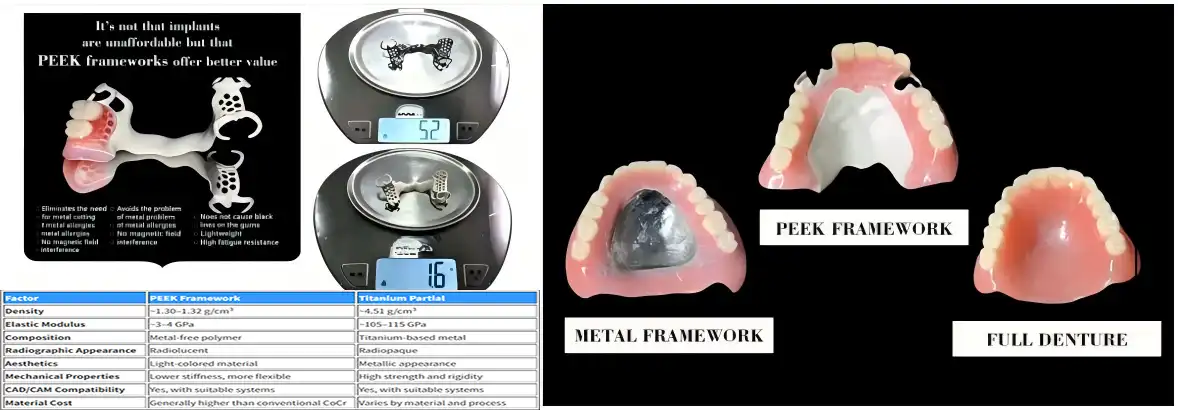
PEEK may be worth considering when low weight, metal-free composition, and appearance are important priorities.
Titanium may be more appropriate when greater rigidity and structural strength are required.
It is also important to distinguish material properties from clinical performance. The available research on PEEK removable partial denture frameworks includes comparisons with cobalt-chromium, while direct clinical evidence comparing PEEK and titanium frameworks remains limited.
Neither material is universally superior. The final decision should be based on the clinical indication, framework design, and mechanical requirements of the restoration.
Clinical Indications
Removable Partial Dentures (RPDs)
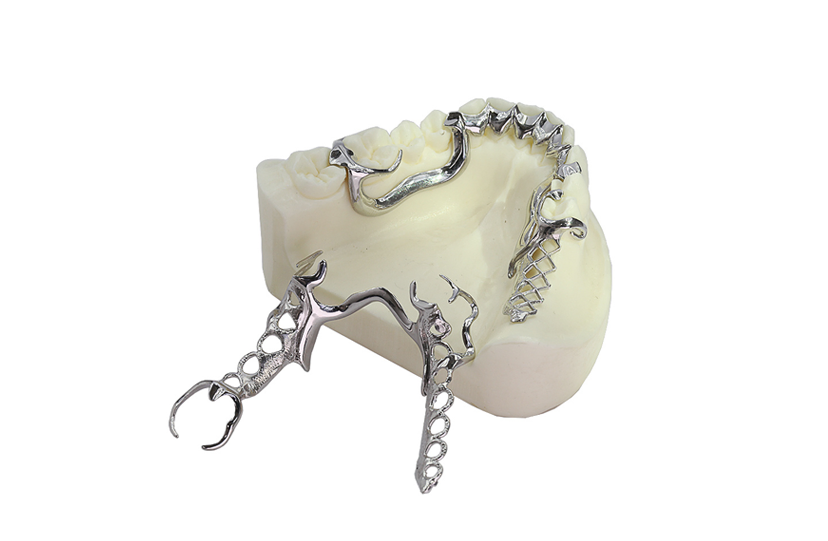
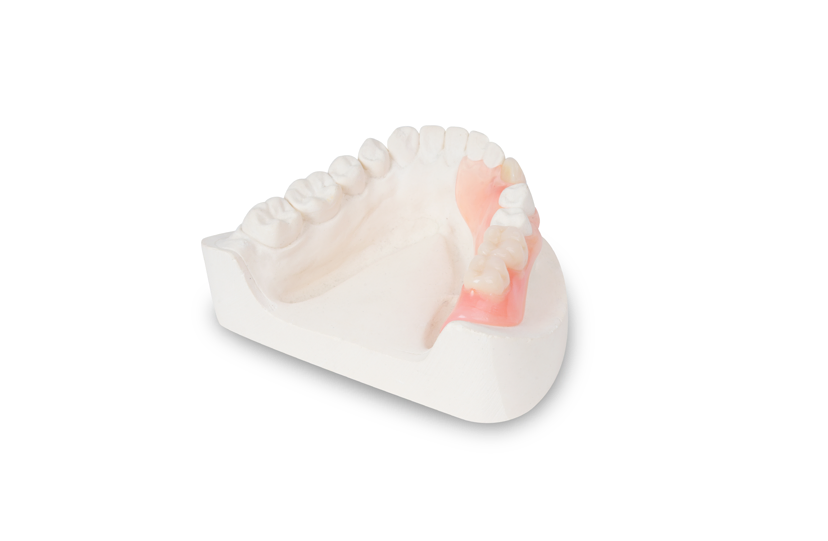
PEEK can be used in selected removable partial denture designs where a lightweight, metal-free framework is desired.
Its lower density may reduce the overall weight of the prosthesis. However, the framework must still provide adequate support, retention, and stability.
The design should be evaluated based on the remaining teeth, available undercuts, occlusal conditions, and the distribution of functional forces.
Implant Bar Overdentures
PEEK has also been investigated for use in implant-supported prosthetic structures, including certain bar and framework applications.
Its mechanical characteristics differ from those of conventional metal materials. However, its suitability for a particular implant-supported overdenture depends on the framework design, connection requirements, and expected functional loading.
Clinical indications should be determined by the treating clinician.
Allergy-Sensitive Cases
For patients with documented sensitivity to certain metals, PEEK may be considered as an alternative material.
Its metal-free polymer composition distinguishes it from cobalt-chromium and titanium alloys.
However, material selection should be based on the patient's documented sensitivity and the complete composition of the proposed prosthesis. PEEK should not automatically be considered suitable for every patient with a history of material allergies.
Materials and Manufacturing Workflow
Raw Materials
The quality of a PEEK framework starts with the raw material.
Dental laboratories should select PEEK blanks or discs specifically intended for dental or medical applications and review the manufacturer's technical documentation.
Biocompatibility evaluation, material traceability, and compliance with applicable regulatory requirements are important considerations when selecting a material supplier.
Production Time
HYC Dental Lab’s normal production cycle is approximately 3 days, depending on the case requirements and order details. For cases involving more complex designs or special requirements, the production schedule can be confirmed before the order is started.
Milling and Processing
The digital manufacturing process typically begins with scanning and CAD design.
After the framework has been designed, suitable CAD/CAM equipment is used to mill the restoration from a PEEK blank or disc.
Following milling, the framework undergoes finishing and any required surface treatment. If acrylic or composite materials are incorporated, the appropriate bonding procedures should be followed.
The accuracy of the final restoration depends on the entire workflow, from digital data acquisition to milling and finishing.
Quality Control
Quality control is essential for ensuring that the finished framework meets the intended design specifications.
Important inspection areas include:
Framework dimensions and overall fit.
Rest seat and clasp design, where applicable.
Connector thickness and structural integrity.
Surface quality and finishing.
Bonding interfaces between different materials.
Compatibility with the prescribed prosthetic design.
Appropriate inspection procedures help identify manufacturing issues before the restoration is delivered to the dental clinic.
Cost Factors
The cost of a PEEK framework depends on several factors.
Raw material type and blank size influence the initial material cost. CAD/CAM milling complexity, including clasp design, arch span, connector dimensions, and framework geometry, also affects production time.
Additional processing requirements, such as surface treatment, bonding, and veneering, may increase the overall cost.
For dental laboratories purchasing frameworks or outsourcing production, it is also important to consider turnaround time, quality control, material traceability, and remake policies.
Comparing suppliers based on the complete manufacturing process rather than material price alone can help laboratories make better purchasing decisions.
How to Choose a PEEK Framework Supplier
Choosing a dental laboratory or material supplier involves more than comparing prices.
Before placing an order, dental laboratories and clinics should consider the following factors:
Certifications and regulatory compliance: Review the supplier's applicable quality management certifications, regulatory status, and supporting documentation. Verify claims rather than relying on general statements about FDA or CE approval.
Material traceability: Ask for the manufacturer's information, material specifications, and relevant biocompatibility documentation for the PEEK blanks being used.
Turnaround time: Confirm the actual production schedule, shipping arrangements, and communication process before submitting cases.
Remake policy: Understand the warranty period, conditions for free remakes, and procedures for addressing fit or manufacturing issues.
Customization capabilities: Confirm whether the supplier can work with your digital files and accommodate the framework design and case requirements.
A reliable supplier should be able to explain its materials, production workflow, quality control procedures, and after-sales support clearly.
Maintenance
Proper maintenance helps preserve the condition of PEEK frameworks and the overall dental prosthesis.
Patients should follow the cleaning instructions provided by their dentist. In general, a soft toothbrush and a suitable non-abrasive denture cleanser can be used for routine cleaning.
Harsh chemicals and cleaning products that are not recommended for the specific material should be avoided.
During follow-up appointments, clinicians should evaluate framework fit, retention, contact areas, and the condition of any bonded acrylic or composite components.
Regular professional examinations are important because changes in the patient's oral tissues and remaining teeth may affect the fit of a removable partial denture over time.
Key Takeaways
PEEK and titanium offer different advantages in removable dental prosthetics.
PEEK is lightweight, metal-free in its polymer composition, and has a relatively low elastic modulus. These characteristics make it an alternative material for selected removable partial denture and implant-supported prosthetic applications.
Titanium offers greater stiffness and high mechanical strength, making it suitable for applications where structural rigidity is a priority.
Neither material is appropriate for every case. Dental professionals should consider patient anatomy, occlusal requirements, framework design, material properties, and long-term maintenance before making a selection.
For dental laboratories, working with a supplier that provides reliable material documentation, consistent manufacturing quality, and clear communication is equally important.
FAQ
Is PEEK safe for long-term dental use?
Dental-grade PEEK has been investigated and used in various dental applications because of its favorable biocompatibility and mechanical properties. However, long-term suitability depends on the specific material formulation, intended application, and supporting clinical evidence. The manufacturer's documentation should always be reviewed.
How does PEEK compare to cobalt-chrome in removable partial dentures?
PEEK is lighter and has a lower elastic modulus than cobalt-chrome. It also offers a metal-free polymer composition and a different aesthetic appearance. Cobalt-chrome is considerably stiffer and has an established history of use in removable partial denture frameworks. The choice depends on the clinical requirements and framework design.
Can a PEEK partial denture be repaired?
Some PEEK prosthetic components can be repaired or modified using appropriate techniques and bonding systems. However, the repair method depends on the type and location of the damage. Dental professionals should consult the material manufacturer's instructions and evaluate whether repair or replacement is more appropriate.
Does PEEK show on dental X-rays?
PEEK is radiolucent, meaning it does not appear as a radiopaque structure in the same way as metal materials. This can help clinicians evaluate surrounding anatomical structures. Other components incorporated into the finished prosthesis may still be visible on radiographs.
What is the typical lifespan of a PEEK framework?
There is no single established lifespan that applies to every PEEK framework. Longevity depends on material quality, framework design, occlusal loading, patient habits, maintenance, and clinical follow-up. Regular professional examinations help identify problems that may affect long-term performance.
Is PEEK suitable for implant-supported overdentures?
PEEK has been investigated for selected implant-supported prosthetic applications, including framework and bar-related designs. However, suitability depends on the mechanical requirements, implant connections, framework dimensions, and clinical indication. It should not be assumed to replace titanium in every implant-supported case.
What certifications should a dental laboratory check when purchasing PEEK materials?
Dental laboratories should review the material manufacturer's technical documentation, applicable biocompatibility evaluation, and regulatory compliance information. ISO 10993-1 is relevant to biological evaluation of medical devices, while ISO 13485 relates to quality management systems for medical devices. FDA registration and device authorization should also be distinguished when reviewing supplier claims.
Can PEEK frameworks be milled using standard CAD/CAM systems?
PEEK frameworks can be manufactured using suitable CAD/CAM milling systems. However, the equipment, milling tools, material blanks, and processing parameters must be compatible with PEEK. Dental laboratories should follow the material manufacturer's recommendations to achieve the intended fit and surface quality.
What should US dental laboratories look for when choosing a PEEK framework supplier?
US dental laboratories should evaluate material traceability, manufacturing capabilities, digital file compatibility, quality control procedures, production lead times, and after-sales support. It is also important to review applicable regulatory documentation and confirm that the supplier can meet the laboratory's specific case requirements.
Can dental clinics outsource PEEK framework fabrication to an overseas dental laboratory?
Yes. Dental clinics and laboratories may work with overseas dental laboratories for custom prosthetic fabrication. Before starting a partnership, they should confirm digital workflow compatibility, shipping arrangements, case communication procedures, quality inspection standards, and applicable US import and regulatory requirements.
What digital files should I send to a dental lab for PEEK framework fabrication?
The required files depend on the laboratory's design and manufacturing workflow. Common digital submissions include intraoral or model scans, opposing arch data, bite registration, and relevant design information. Before submitting a case, confirm the accepted file formats and whether additional clinical records or instructions are required.
How can I evaluate the quality of a custom PEEK dental framework?
Dental laboratories and clinics should evaluate framework fit, dimensions, clasp design, connector thickness, surface finishing, and compatibility with the prescribed design. Material documentation and manufacturing quality control records are also important when assessing a supplier.
Discuss Your Dental Laboratory Requirements with HYC
Choosing the right framework material is only one part of producing a reliable dental restoration. Digital design, manufacturing accuracy, quality inspection, and communication between the clinic and laboratory also play important roles.
HYC Dental Lab works with dental professionals on removable and fixed dental prosthetic requirements. If you are considering PEEK frameworks or other removable prosthetic solutions, contact our team to discuss your case specifications and confirm current material and production availability.
For inquiries, email us at info@hycdentallab.com or visit hycdentallab.com.
References
Srivastava, G., et al. "Performance of polyetheretherketone (PEEK) versus cobalt chromium to fabricate removable partial denture frameworks: A systematic review." The Journal of Prosthetic Dentistry, 2025. DOI: 10.1016/j.prosdent.2025.05.034
Bertotti, K., et al. "Accurate analysis of titanium and PolyEtherEtherKetone materials as an alternative to cobalt-chrome framework in removable partial denture: A systematic review." Dental Materials, 2024. DOI: 10.1016/j.dental.2024.07.036
Zhao, K., et al. "Suitability and Trueness of the Removable Partial Denture Framework Fabricating by Polyether Ether Ketone with CAD-CAM Technology." Polymers, 2024, 16(8), 1119. DOI: 10.3390/polym16081119
"Clinical Applications of Polyetheretherketone in Removable Dental Prostheses: Accuracy, Characteristics, and Performance." Polymers, 2022, 14(21), 4615. DOI: 10.3390/polym14214615
"A three-dimensional finite element analysis of mechanical function for 4 removable partial denture designs with 3 framework materials: CoCr, Ti-6Al-4V alloy and PEEK." Scientific Reports, 2019. DOI: 10.1038/s41598-019-50363-1
Ge, Y., et al. "A completely digital workflow for PEEK removable partial dentures: A preliminary clinical study." The Journal of Prosthetic Dentistry, 2025. DOI: 10.1016/j.prosdent.2025.05.028
Hegazi, H. M., et al. "Patient-centered outcomes of indirect CAD-CAM removable partial denture frameworks: A 2-year follow-up study." Journal of Prosthodontics, 2025, 34(8), 818–826. DOI: 10.1111/jopr.14100
YOU MAY LIKE