Wholesale Implant Cemented Crown Supplier and Manufacturer
Dental professionals and procurement managers need to find a wholesale Implant Cemented Crown provider and maker they can trust. They need a partner that combines precision engineering with regulatory excellence. One of the most visually pleasing restorative dentistry options today is the Implant Cemented Crown, which fits in perfectly with the patient's natural teeth and doesn't show any hardware. Our production process puts first-time fit accuracy, excellent biocompatibility, and fast delivery at the top of the list. These are important factors that have a direct effect on how efficiently your clinic works and how satisfied your patients are.
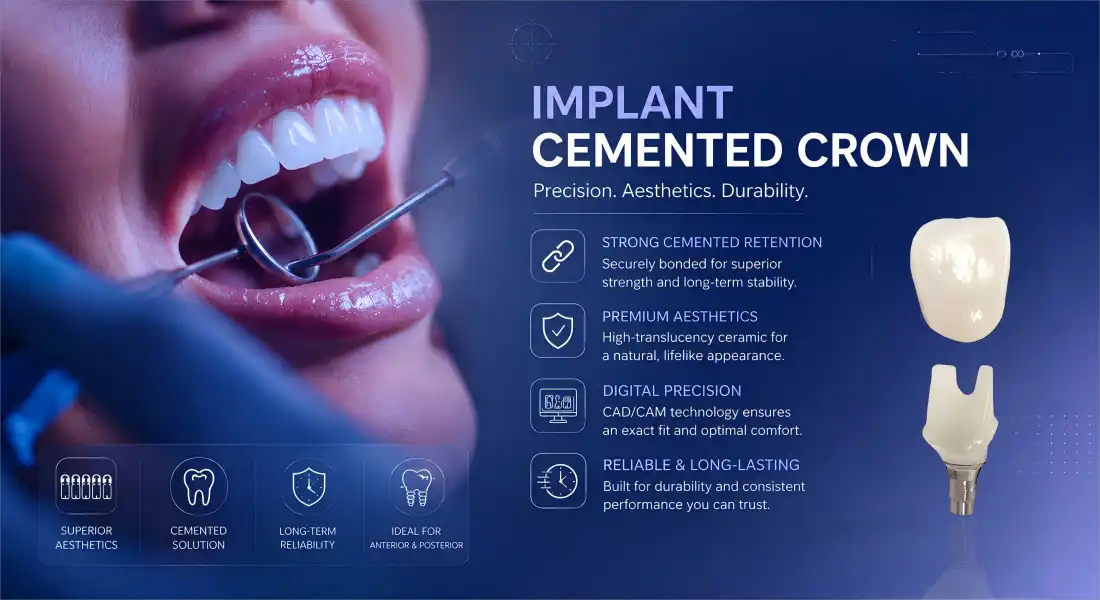
Understanding Implant Cemented Crowns: Key Concepts and Benefits
The way that Implant Cemented Crowns are attached is very different from how screw-retained crowns are attached. In order to complete the repair, two main parts are needed: a custom or stock abutment that is screw-retained directly to the implant fixture and a crown that is permanently attached to this abutment using dental cement. This two-part design gets rid of the need for screw access holes that go through the occlusal surface. This keeps the crown's structural stability and keeps the same look.
Material Selection and Structural Properties
Our production line can make a lot of different shapes and sizes of materials to meet clinical needs. Abutments are made from titanium or zirconia, which is chosen based on how they look and how the flesh reacts to them. Crown superstructures are made of three main types of materials:
- Zirconia monolithic restorations: These are ideal for both anterior and posterior restorations where high strength is essential. They typically offer flexural strength exceeding 900 MPa while providing improved translucency compared with conventional zirconia materials.
- Porcelain-fused-to-metal (PFM) designs: Traditional PFM crowns are both cost-effective and long-lasting, but they can't be used in cases with a high smile line because the gums may turn gray.
- All-ceramic solutions: Lithium disilicate and stacked porcelain are two all-ceramic choices that let more light through in the front areas where a natural look is most important.
Choices of materials affect not only how something looks, but also how quickly and easily it can be made again. Our expert team helps procurement workers match the needs of the materials they're buying with the types of patients and clinical cases they want to see.
Clinical Advantages Driving Procurement Decisions
The Implant Cemented Crown form has a number of real perks that have a direct effect on practical value. Because there is no screw access channel through the occlusal surface, the restoration may demonstrate improved fracture resistance in certain clinical situations by reducing stress concentration within the crown. Clinical studies have reported excellent long-term survival, with many restorations remaining functional for more than 10–15 years when appropriate case selection, maintenance, and oral hygiene are provided.
Another important benefit is that angulation adjustment is available. When the site of an implant is off from the ideal prosthetic axis, which can happen when the bone structure isn't strong enough, Custom abutments can compensate for implant angulation within clinically acceptable limits, depending on the implant system and restorative design, helping achieve an ideal prosthetic emergence profile. This compensation feature saves cases that would have needed screw-retained prostheses with access holes that are in strange places or screw channels that are at odd angles.
The cementation layer itself acts as a surface that relieves stress. Screw-retained designs have hard metal-to-metal contact, but the thin cement film lets the metals make small changes while seating. This may facilitate passive seating and improve stress distribution between the restoration and the abutment, depending on the clinical situation.
Indications and Contraindications for Clinical Application
When it comes to looks, Implant Cemented Crowns work best in areas like the front of the maxillary teeth, where patients and dentists don't like the idea of obvious repair hardware. They also solve problems caused by a small vertical restorative space in posterior segments, where limited restorative space may make screw-retained restorations less favorable.
But some anatomical and practical situations call for different methods. When functional loads are put on short abutments that don't have enough holding form (usually less than 4 mm in height), they could break. Deep subgingival borders that are more than 2 mm make it harder to remove the cement, which raises the risk of peri-implantitis. Patients who have had inflammatory peri-implant disease in the past need to be carefully evaluated on a case-by-case basis, as residual cement particles can cause tissue to break down quickly.
Comparing Implant Cemented Crowns with Alternative Solutions
When making decisions about what to buy, it helps to know how Implant Cemented Crowns fixed repairs stack up against other options. Screw-retained crowns offer the important advantage of retrievability. However, the screw access channel may compromise esthetics in certain anterior cases and may slightly influence restoration strength depending on the restorative material and design.Long-term survival rates for both systems are about 95% at ten years, according to clinical research. However, the types of complications are very different.
Mechanical and Clinical Performance Metrics
Residual subgingival cement remains one of the most commonly reported biological complications associated with cement-retained restorations when excess cement is not completely removed. Implant Cemented Crowns have a lower rate of this happening. But they have a higher chance of medical complications when the cementation methods aren't right. Even with careful technique, about 8–10% of the time, residual cement pieces move under the gums. This can cause inflammatory reactions that make it harder for the bone to fuse.
When it comes to the patient experience, Implant Cemented Crown patterns get rid of the small occlusal irregularity that can be seen around screw access composite fillings. Compared to screw-retained options with repair gaps at the access site, this smooth surface makes you feel better and stops plaque from building up.
Optimal Clinical Scenarios
When it comes to treating the maxillary central incisor area, Implant Cemented Crowns work better than other options. This is because even well-finished screw access sites can show small color or texture differences in some lights. They are also great for fixing implant misalignments because the custom abutment works as a bridge and realigns the prosthetic axis without having to go through a lot of complicated lab processes.
Instead, mandibular molar sites with a lot of vertical space and low aesthetic standards may benefit more from the ability to remove screws. This is especially true for patients who need professional care on a regular basis or who have medical conditions that make minor surgeries more difficult.
Sourcing and Procurement: Buying Implant Cemented Crowns Wholesale
In order to build ties with reliable wholesale Implant Cemented Crown suppliers, you need to look at more than just unit price. Cost management, quality assurance, reliable delivery, and regulatory compliance are all important parts of buying that must be balanced in order to keep your lab or clinic's image.
Supplier Evaluation Criteria
Quality management certificates are the basis for judging a seller. The ISO 13485:2016 certification shows that the manufacturing processes are controlled in a planned way. FDA establishment registration and CE certification (where applicable) indicate that the manufacturer complies with applicable regulatory requirements for their respective markets. Together with ISO 13485 certification, these demonstrate a commitment to quality management and traceability. These certificates aren't just pieces of paper; they're audited proof of consistent testing for biocompatibility, material tracking, and production quality control.
Your business freedom is directly affected by how much you can produce and how much you can customize. Suppliers who offer true 100% customization based on digital case files, rather than just changing stock patterns, have better profiles for marginal adaptation and growth. This ability to customize cuts down on the time and number of remakes needed for chairside adjustments, which saves money even if the price per unit is higher.
Pricing Structures and Volume Considerations
Implant Cemented Crowns usually cost depends on the material chosen, the difficulty of the support, and the number of units ordered. Zirconia monolithic replacements usually cost more because of the high cost of the material and the special cutting skills needed to make them. PFM units, on the other hand, are more affordable for practices that want to start using them.
Many manufacturers offer volume discounts based on annual purchasing commitments and order quantities, although the actual savings vary among suppliers.But procurement managers have to weigh these savings against the costs of keeping inventory and the chance that changes in specifications will make stored inventory useless.
Logistics and Delivery Reliability
Dental cases have tight deadlines that make performance in delivery impossible to avoid. Our normal production time from receiving a case to sending it is three to four business days. For pressing clinical needs, we offer express choices that can deliver finished restorations within 48 hours. It's possible for this response time to happen because case input, design, manufacturing, and quality control are all connected digitally, so there are no delays caused by handoffs.
For international transfers to go smoothly, handling must be carefully coordinated. We work with reliable international courier partners that provide efficient customs documentation support and dependable global delivery services. This way, we can make sure that your cases get through border checks without any delays that could cause patients to miss their appointments.
Top Manufacturer Brands and Trusted Suppliers in the Implant Cemented Crown Market
The global Implant Cemented Crown market includes numerous providers, but there are real differences when you look at production mindset and quality assurance depth. Leading makers set themselves apart by investing in cutting-edge CAD/CAM systems, developing their own materials, and making their quality paperwork clear.
Competitive Advantages in Modern Manufacturing
We've been experts in this field for 22 years and have come up with manufacturing methods that solve common problems in buying. At three stages of production, our quality control process checks the dimensions: after the design, after the cutting, and before the pre-sintering step; and finally, after the finishing step. With this triple-check method, the first try at fitting is successful more than 96% of the time. This cuts down on the expensive remake cycles that hurt profits and customer relationships.
Finding the right materials is another important way to set yourself apart. Our metal alloys and zirconia materials are sourced from internationally recognized manufacturers and are supplied with complete material certificates, traceability records, and biocompatibility documentation. This clear paperwork gets rid of any doubts about compliance when your business is inspected or reviewed for accreditation.
Client References and Performance Validation
Potential buyers should ask for case studies that show how well a provider can handle a range of healthcare situations. Our clients include dental service organizations with multiple locations that handle more than 200 cases a month, small cosmetic practices that need the utmost in looks, and implant specialty centers that handle complicated full-arch rehabilitations. This variety shows that our systems can grow and change to meet different quality standards and process styles.
Specific performance measures, like remake rates below 2%, average arrival times, and customer service response times, are shown in testimonials that are more useful than general happiness statements. We recommend that people who work in buying ask for direct references from clients whose case loads and places are similar to yours.
Ensuring Long-Term Success with Implant Cemented Crowns
Getting the best clinical results with Implant Cemented Crowns requires more than just using the right product. It also requires using the right method and being proactive about managing complications. Support from suppliers in these areas sets transactional sellers apart from manufacturers who really want to work together.
Preventing Cement-Related Complications
Too much cement retention is the main biological problem that comes with Implant Cemented Crowns. Inflammatory reactions are set off by residual particles and can lead to peri-implantitis, which threatens the life of the implant. Best practices today focus on preventing problems by making designs better and improving professional techniques.
Whenever clinically appropriate, custom abutment margins are designed approximately 0.5–1 mm below the gingival margin to facilitate excess cement removal while maintaining esthetic outcomes. Usually, the margins are hidden 2-3 mm below the gum line, which makes it very hard to remove the cement without reshaping the tissue. This shallow placement is different.
The copy abutment method lowers the risk of cement retention even more. By using flexible material to make a copy of the abutment at the dentist's chair, they can place the crown outside of the mouth, squeeze out any extra cement in a controlled setting, and then move the pre-vented repair to the patient's mouth. Compared to straight intraoral cementation, Clinical studies have shown that this technique can significantly reduce excess cement compared with conventional intraoral cementation methods.
After-Sales Support and Warranty Protection
Our guarantee program protects you financially against problems with the way the product was made and encourages you to keep the quality high. Fixed restorations come with a two-year guarantee that our warranty covers verified manufacturing defects, including material failure and workmanship issues, in accordance with our warranty policy. We offer free replacement restorations with fast three-day creation and free shipping during the guarantee time.
Technical support includes more than just guarantee claims. It also includes help with case planning, choosing materials, and fixing problems in difficult cases. Our clinical liaison team is made up of experienced dental techs and prosthodontic specialists who can help you by phone or email during business hours. This gets rid of the time zone issues that make working with foreign suppliers harder.
Emerging Innovations in Crown Technology
New discoveries in material science keep changing the artificial environment. High-translucency zirconia formulations now achieve light transmission levels similar to lithium disilicate while keeping zirconia's greater strength. This allows single-material indications to be used in aesthetic areas that used to require layered porcelain. These materials make production easier and stop porcelain from chipping, which is the most common technical issue with standard PFM and layered repairs.
Another new area is digital cementation methods. Modern light-cured and dual-cured resin cements provide improved working time and controlled polymerization for selected clinical situations. Even though these technologies aren't widely used yet, they might be in the next round of growth.
Conclusion
Finding the right wholesale partner for Implant Cemented Crowns means balancing a number of important factors. These include precise manufacturing to ensure a perfect fit every time, regulatory compliance to keep your practice safe from liability, fast delivery to keep patients on schedule, and after-sales support to give you peace of mind when problems arise. Our track record over the past 20 years shows that we have stayed true to these beliefs. This is supported by documented quality measures and client testimonials from practices like yours. Implant Cemented Crowns remain an important restorative option in modern implant dentistry, particularly for cases where esthetics and prosthetic flexibility are priorities. Working with a manufacturer that understands both your technical needs and the business pressures you're under can give you competitive advantages that go beyond individual case outcomes.
FAQ
How long do cemented implant crowns typically last?
Systematic reviews have reported survival rates exceeding 90–95% over approximately 10 years, depending on case selection, restorative materials, maintenance, and patient-specific factors. Many restorations remain functional for longer than 10 years with appropriate care.A lot of repair work lasts well for fifteen years or more. Longevity relies on many things, such as occlusal pressure, how well patients take care of their teeth, regular professional upkeep, and the quality of the initial creation. Using the right margins and removing all the cement during transport can greatly increase the service life by avoiding inflammation issues.
What certifications should I verify when choosing a manufacturer?
Give more weight to sellers who have ISO 13485:2016 approval for managing the quality of medical devices, FDA registration to get into the U.S. market, and CE marking for shipping in Europe. Ask for documentation of FDA establishment registration (where applicable), ISO 13485 certification, CE certification for relevant markets, and material biocompatibility reports in accordance with ISO 10993 standards. These licenses show that quality control is always being done and that regulations are being followed.
How do costs compare between cemented and screw-retained options?
Depending on the materials used and the difficulty of the abutment, lab fees for Implant Cemented Crowns are usually within a moderate range per unit. Screw-retained crowns also fall within a comparable pricing range, and the cost depends more on the material chosen than on the method of retention. Possible redo costs should be added to the total cost of the case. Because Implant Cemented Crown designs fit better, the total cost of ownership is often lower, even if the initial investment is similar.
Can I request samples before committing to large orders?
Reliable makers offer sample kits or trial cases so that you can check the quality before committing to a large order. We can send you a sample Implant Cemented Crown so that your team can check the minor fit, dental anatomy, surface finish, and shade accuracy against your quality standards. This method of reducing risk helps us all understand what to expect from each other and boosts trust in our manufacturing skills.
Partner with HYC for Your Implant Cemented Crown Supply Needs
HYC offers Implant Cemented Crown solutions that are made to meet the specific needs of current dentistry labs and practices. Our FDA-registered and ISO 13485:2016-certified factory makes 100% custom repairs with first-time fit rates of over 96%. This means that you won't have to do as many remakes, which slows down your work and lowers your profits. When you buy something, you should think about more than just the quality of the product. You should also think about how reliable the delivery is. Our standard three-day production cycle and express 48-hour options keep your patients' schedules on track, and our two-year warranty on fixed restorations protects your finances and shows that you trust our quality systems. Our technical team is ready to talk about your needs, whether you're a dental service company with multiple locations, an implant specialty center, or an independent laboratory looking for a reliable Implant Cemented Crown provider. Email us at info@hycdentallab.com to get sample cases, see our full list of products, or talk about custom pricing models for large orders that fit your needs.
References
1. American College of Prosthodontists. Clinical Guidelines for Implant-Supported Single-Tooth Restorations. Journal of Prosthetic Dentistry, 2021.
2. Chee, W., & Felton, D. A. Cemented versus Screw-Retained Implant Prostheses: Which is Better? International Journal of Oral & Maxillofacial Implants, 2020.
3. Sailer, I., Strasding, M., Valente, N. A., & Zwahlen, M. A Systematic Review of the Survival and Complication Rates of Zirconia-Ceramic Implant-Supported Single Crowns. Clinical Oral Implants Research, 2018.
4. Wilson, T. G. The Positive Relationship Between Excess Cement and Peri-Implant Disease: A Prospective Clinical Endoscopic Study. Journal of Periodontology, 2019.
5. Wittneben, J. G., Joda, T., Weber, H. P., & Bragger, U. Screw Versus Cement: A Systematic Review of Prosthetic Complications. International Journal of Prosthodontics, 2017.
6. Zurdo, J., & Romao, C. Survival and Complication Rates of Implant-Supported Fixed Partial Dentures with Cantilevers: A Systematic Review. Clinical Oral Implants Research, 2019.
YOU MAY LIKE
 Framework.webp "High-Performance Polymer (HPP) Framework")