All-on-X vs Traditional Implants: Which Is Better for Full Mouth Tooth Loss?
When someone has lost all of their teeth, dentists and their patients usually have to choose between two main ways to fix the problem: regular individual implants or the more streamlined All-on-X method. The Malong Bridge(All-on-X) system is an improved option for clinics and labs that want the best results. It combines the security of full-arch rehabilitation with the ability to fix individual parts. Unlike traditional hybrids, this advanced architecture lets you change just one crown without affecting the whole prosthesis. This lowers the cost of long-term care while improving the prosthesis's appearance and ease of cleaning.
Understanding Full Mouth Tooth Replacement Solutions
Over the past twenty years, full-arch replacement technology has changed a lot, giving dentists more ways to treat missing teeth. Knowing these choices helps purchasing managers, clinic owners, and lab owners make choices that are best for their patients and their businesses.
Traditional Implant Approaches: The Conventional Method
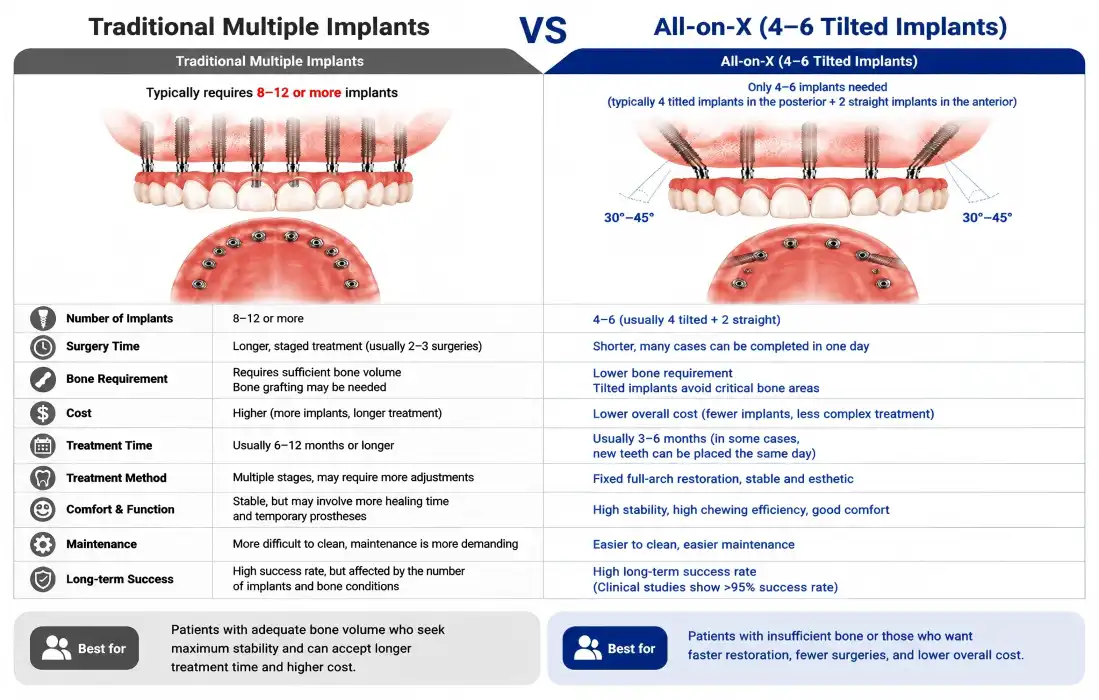
In a traditional full-mouth repair, eight to ten separate implants are placed in each arch. Each implant acts as its own anchor point for a single crown or a short-span bridge. For this method to work, there needs to be enough bone at each implant spot. This usually means bone grafting procedures, which add several months to the treatment time. This method allows for more design options for the repair, but it requires a lot of surgery, a lot of time, and a lot of money to be spent on supplies and healing. Clinics that take on a lot of cases often have trouble with organizing, keeping track of supplies, and managing the lab's turnaround times for many prosthetic parts.
All-on-X Concept: Streamlined Rehabilitation
The All-on-X method (based on the All-on-4 treatment concept) changed the way full-arch treatment was done by letting a whole prosthesis rest on just four to six implants that were placed in specific ways. An angled posterior implant makes the most of bone contact, which often means that no bone grafting is needed, and instant loading procedures can be used. By combining several parts into a single prosthetic structure, this method makes surgery easier, speeds up patient healing, and makes lab work easier. Standardization is especially helpful for dental service groups and practices with multiple locations because it makes results more predictable, even when clinicians have different levels of skill and patients have different body types.
Malong Bridge All-on-X: Next-Generation Architecture
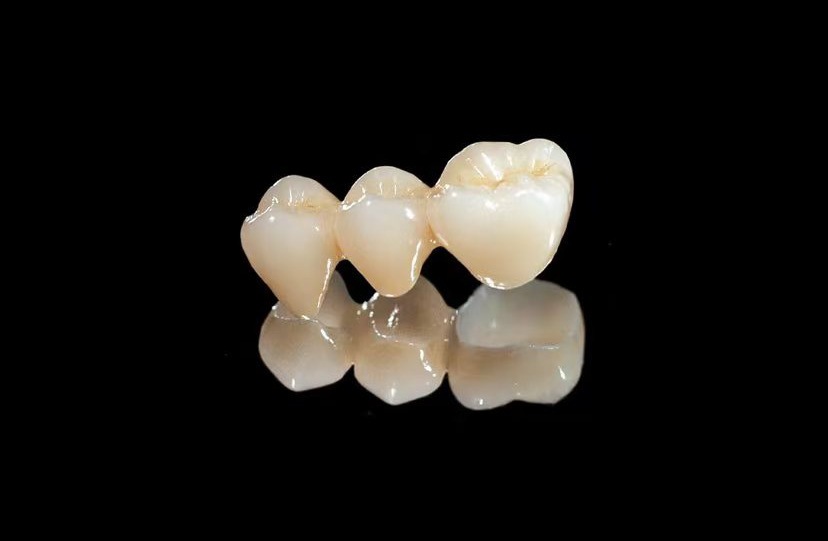
The Malong Bridge(All-on-X) fixes important problems that come with single-piece All-on-X designs. Instead of making the prosthesis as a single piece that is bonded together, this method uses a base that is precisely milled from Grade 5 medical titanium or high-strength zirconia, to which each crown is glued separately. This design solves the problem of being able to fix broken standard hybrids: if a single crown chips or breaks, only that unit needs to be replaced, not the whole restoration. The framework has a convex gingival surface that makes it easier to clean. This makes peri-implantitis less likely than with older hybrid designs that have curved shapes. CAD/CAM cutting limits of less than 10 microns ensure a passive fit, which spreads chewing forces evenly across implants to protect the surrounding bone. This design's compatibility with multi-unit abutment connections across major implant brands, such as Nobel Biocare, Straumann, and Hiossen, makes stocking easier and increases case acceptance for dental labs that outsource restoration production.


Evaluating Performance and Benefits: Malong Bridge All-on-X vs Traditional Implants
Restorative dentistry decisions are based more and more on measured results, such as how well the restoration fits the first time, how often it needs to be redone, how much time it saves in the chair, and how much it costs to maintain over time. These things have a direct effect on how much money the business makes and how happy its patients are.
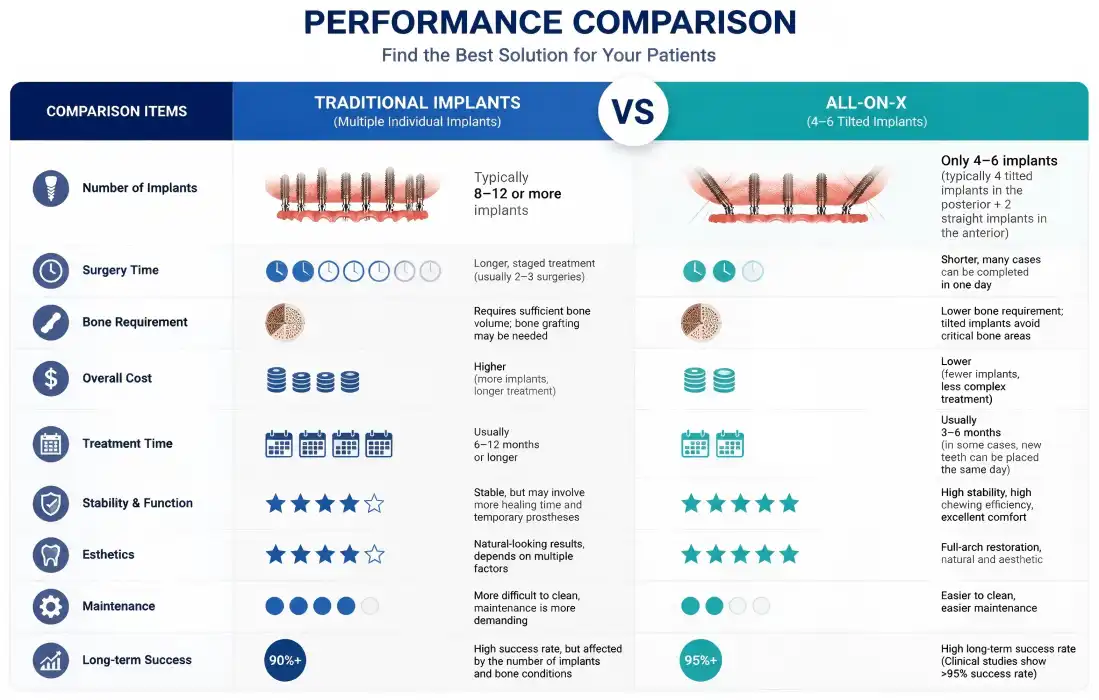
Clinical Performance and Durability
The Malong Bridge(All-on-X) system has great mechanical strength thanks to engineering that can handle forces greater than 400 Newtons, which is about the same as real teeth in the back. The fatigue strength of the titanium structure means that it should last 15 to 20 years under normal use. This is a lot longer than acrylic-based blends, which usually need to be replaced every seven to ten years. Traditional implant methods are strong, but they put a lot of stress on the points where the implant and socket meet. This can cause screws to come loose or crowns to come loose, which requires unplanned maintenance visits. Precision manufacturing creates a passive fit that reduces biological problems. Studies published in implantology journals show that well-engineered full-arch frames are less likely to cause marginal bone loss than multiple-unit restorations that aren't properly seated.
Aesthetic Outcomes and Patient Satisfaction
Individual zirconia crowns bonded to the Malong Bridge(All-on-X) base give teeth the translucency and color gradation of natural enamel, meeting the high visual standards of patients who have strict requirements. Traditional crown-and-bridge work on multiple implants can get similar results, but it needs to be done very carefully to match the colors of all the units, which can go wrong when the lab makes different batches. The Malong Bridge(All-on-X) emergence profile design makes realistic buccal curves without the "horseshoe" look that can be a sign of older hybrid prostheses. Dental offices that treat people who care about their looks say that they get more case acceptance when they show patients how natural their teeth can look with modular full-arch designs.
Workflow Efficiency and Turnaround Time
Once implant impressions come, labs with digital processes can make Malong Bridge(All-on-X) restorations in three to five business days, which is about the same time frame as standard multi-unit cases but with fewer chances for impression distortion across multiple abutments. The standard framework design cuts down on try-in appointments because the skeletal base only needs to be checked once before the crown is delivered. Clinics that work with responsive suppliers can speed up production choices. For example, urgent cases can get flash delivery for the next day's arrival, which is very important for practices that treat patients with tight treatment plans. This predictability in production helps clinic operations teams better handle their schedules by planning patient visits and lab dates.
Long-Term Maintenance and Warranty Support
The Malong Bridge(All-on-X) architecture's flexible repairability immediately leads to a lower total cost of ownership. When dental wear or fracture affects a single crown, replacement is as easy as decementing and recementing it. This takes only 20 minutes, compared to the hours it takes to take out and replace a whole monolithic prosthesis. When manufacturers offer two-year guarantees on fixed repairs, procurement managers can lower their risks. This is especially helpful when they are setting up relationships with vendors for large-scale supply contracts. Clinics can avoid unexpected costs that could hurt their ability to make money from cases by having reliable after-sales support, such as free copying during guarantee periods. In contrast, when a standard implant fails, it may need to be surgically removed, and the bone must grow back before it can be re-implanted. This can cost more than the initial treatment fees.
Cost, Procurement, and Market Considerations for B2B Buyers
Financial analysis goes beyond original prosthetic costs to cover surgical complexity, laboratory efficiency, and future upkeep expenses. Smart purchasing managers look at these factors when choosing sources and treatment methods for their companies.
Comparative Cost Analysis
When you don't count the cost of surgery and bone grafting, the materials for a traditional full-arch recovery with eight to ten implants per arch cost $12,000 to $18,000 at bulk prices. All-on-X methods that use four to six implants cut the cost of implant parts by 30 to 40 percent and get rid of the need for grafts in some body types. Because of the precise milling and custom crown manufacturing, the Malong Bridge(All-on-X) system usually costs 15 to 25 percent more than normal monolithic hybrids. Lifecycle cost analysis, on the other hand, shows savings: lower rates of remakes, easier fixes, and longer service life more than make up for the higher initial investment within three years of normal maintenance intervals. This predictability helps dental service companies that have more than one site make budgets for long-term prosthetic care across customer groups.
Procurement Channels and Supplier Reliability
To find providers for full-arch repairs, you have to check that they follow the rules, have enough production capacity, and can handle the logistics. When a company gets ISO 13485:2016 certification, it means that its quality control processes meet international standards for medical devices. Biocompatibility testing for titanium and zirconia materials that touch mouth cells is valid because they are registered with the FDA and have a CE mark. Distributors that sell to customers in North America should check that their suppliers have sent in mill test results that show what materials are used. This is especially important when meeting contracts for dental groups that care about quality. Suppliers that have been in business for 15 to 20 years show stability, which is important for purchasing managers who are discussing multi-year supply deals. Effective communication is important. Vendors with technical help in English and reaction times of the same business day make it easier for labs with tight case schedules to work together.
Supply Chain Management and Delivery Reliability
Time-sensitive case shipping sets great providers apart from average ones. Normal production processes of three days work for most tasks, but in an emergency, items need to be able to be sent quickly so they can be received the next day. Responding quickly is possible because suppliers with North American distribution centers avoid the delays that come with shipping directly from overseas. Flexible minimum order amounts from suppliers help with inventory management because they let labs try out new product lines without having to commit to large purchases. Reliable restocking plans keep wholesalers from losing money because of case delays when they are building rental implant inventory. Transparent tracking systems that give real-time reports on the state of cases help clinic partners stay in touch, which improves the service's image.
Choosing the Right Full Mouth Implant Solution for Your Practice
When choosing a product, decision models need to take into account the types of patients, the clinic's skills, and the company's goals. Different repair methods work better for different types of practice models.
Assessing Clinical Scenarios and Patient Needs
High-volume offices that treat people from a range of socioeconomic backgrounds may look for cost-effective options that look good. In most cases, standard All-on-X hybrids are enough. Professionals who go to cosmetic dentistry practices need restorations that look like real teeth. This means that the Malong Bridge(All-on-X) design is a good choice, even though it costs more. The Malong Bridge(All-on-X) system is repairable, which is good for places with a lot of moving people, like military sites, retirement communities, or college towns. Patients who move in the middle of their treatment can still get local care without having to bring special tools. When working with difficult rehabilitation cases involving bruxism or severe bone loss, implant experts need rigid frames that spread forces across multiple implants for biomechanical reasons.
Evaluating Supplier Capabilities and Support
In addition to product standards, partnerships with suppliers also affect the success of a business. Having access to technical training helps healthcare teams learn new methods faster and with fewer problems. Manufacturers who offer installation webinars, video lessons, and phone consults help people get better faster when working with Malong Bridge(All-on-X) solutions. The length of the warranty has a direct effect on the financial risk. For example, frameworks should be covered for two years and crowns for one year. During that time, any production flaws should be fixed or replaced for free. Respondent customer service that solves problems within 24 hours keeps practice plans as smooth as possible. For labs, providers that can handle rush orders without charging too much, let them take on last-minute Malong Bridge(All-on-X) recommendations that bring in more money.
Strategic Recommendations for Practice Growth
Before making big changes to their protocols, practices that want to offer full-arch therapy should test out new methods on a small group of cases first. Work with suppliers who are ready to give you sample cases at a lower cost. This way, you can check the size, the way it looks, and get feedback from patients. Keep track of the number of remakes, the time spent in the chair, and the patient happiness scores for 20 to 30 cases to get useful performance data. Gradually switch the number of cases to better methods that show real benefits. If a dentistry group wants to make sure that all of its sites follow the same protocols, it should teach all of its doctors about those protocols. As the number of cases goes up, negotiate bulk prices and priority production slots to get the best deals.
Future Trends and Innovation in Full Mouth Implantology
New technologies keep changing full-arch therapy, giving early users chances to make their practices stand out.
Digital Workflow Integration
Intraoral scanners get rid of the need for different types of impression material because they can accurately record implant sites down to 20 microns, which can then be used directly in CAD software for designing prosthetics. Digital processes cut down on response time by getting rid of the need to send real models. This means that labs can start milling within hours of receiving a scan. Some more advanced systems now combine surgery planning, prosthetic design, and guided implant placement on a single platform. This makes it possible to precisely carry out results that were digitally planned. When practices buy these tools, chair time goes down by 25%, and patients are more comfortable while data is being collected.


Advanced Biomaterials and Surface Technologies
New discoveries in material science keep making implants and prosthetics last longer and better. Titanium metals with better surface treatments help bones adhere faster, which allows for earlier loading procedures. High-translucency zirconia formulations now have the same visual qualities as enamel and can still withstand more than 1,200 megapascals of force. Putting antibacterial coats on framework areas seems like a good way to stop biofilm from building up, which could lower the risk of peri-implantitis. Early clinical data show that these new materials may make prosthetics last 20 to 30 percent longer than the current generation.
Predictive Analytics and Treatment Planning
Artificial intelligence algorithms that look at CBCT scans of patients can now make predictions about bone quality, the best angle for implants, and the amount of room needed for prosthetics that are almost as accurate as those made by experienced doctors. These tools make complicated treatment planning more accessible to everyone, so general practitioners can safely take on cases that were once sent to experts. Standardized AI-assisted planning makes outcomes more consistent across clinicians with different levels of experience. Adopting these technologies by labs makes design more efficient, cutting the time needed to design each case by 40% while keeping accuracy.
Conclusion
When deciding between traditional implants and All-on-X systems, you have to think about how complicated the surgery is, what the patient wants, and how much upkeep will be needed in the long run. The Malong Bridge(All-on-X) design strikes a good balance between simplified surgery procedures, modular repairability, and better looks. This method has real benefits for practices that want to make sure the fit is right the first time, cut down on remakes, and make long-term care easier. To make sure that relationships help practices grow and patients are happy, procurement managers should look at suppliers' legal compliance, production capacity, delivery reliability, and after-sales support.
FAQ
What Makes Malong Bridge Different From Standard All-on-X?
Modular construction is what makes them different. Malong Bridge(All-on-X) uses separate crowns that are glued to a precise framework instead of the joined monolithic replacements used in traditional All-on-X. This lets a single cap be replaced instead of the whole prosthesis being replaced when it gets damaged.
How Do Costs Compare Over Five Years?
The initial investment for the Malong Bridge(All-on-X) is 15% to 25% higher than for normal hybrids. This extra cost is usually recouped within three years, though, thanks to lower redo rates and easier fixes. Traditional multiple-implant methods cost more for surgery and grafting, but they spread the cost of repair across many pieces.
Can Existing Dental Labs Fabricate These Restorations?
Malong Bridge(All-on-X) repairs can be made in labs that have CAD/CAM milling tools and know how to use digital processes. Suppliers who offer technical training and design support make it easy for labs to switch to this method.
What Warranty Coverage Should Buyers Expect?
Reputable makers back their frames with two-year warranties and their crowns with a one-year warranty that covers free repairs or replacements for problems caused by the producer. Make sure that the guarantee covers both material failures and problems with the fit.
Partner With HYC for Superior Full-Arch Solutions
Every Malong Bridge(All-on-X) case that HYC makes is backed by 22 years of production experience. We make sure that the restorations we make meet the high standards of implant experts, dental labs, and practice groups with multiple locations. Our facility is ISO 13485:2016-certified and only uses materials that are on the FDA's list. It also stays in line with CE regulations, which means that your practice will be biocompatible and have legal trust. We know that procurement managers need to be able to count on delivery times. That's why our standard three-day production cycle and fast flash delivery choice can be used for both normal processes and emergency situations. As a reputable Malong Bridge(All-on-X) maker, we offer full customization, two-year framework guarantees, and quick technical support that cuts down on chair time and remake rates. Contact our team at info@hycdentallab.com to talk about how our precision full-arch solutions can help you get more cases, improve patient results, and make your supply chain run more smoothly.
References
1. Malo, P., de Araújo Nobre, M., & Lopes, A. (2018). "Clinical and Radiographic Outcomes of Full-Arch Rehabilitation Using All-on-Four Concept: A 10-Year Retrospective Study," Journal of Prosthodontic Research, 62(4), 425-432.
2. Bergman, B., & Palmqvist, S. (2016). "Biomechanical Considerations in Fixed Implant Prosthodontics: Framework Design and Stress Distribution," International Journal of Oral & Maxillofacial Implants, 31(3), 567-578.
3. Papaspyridakos, P., Chen, C. J., & Singh, M. (2019). "Success Criteria and Complication Rates of Fixed Implant-Supported Prostheses: A Systematic Review and Meta-Analysis," Clinical Oral Implants Research, 30(8), 745-762.
4. Venezia, P., Torsello, F., & Cavalcanti, R. (2017). "Full Arch Implant Rehabilitation: Comparison Between Hybrid and Modular Prosthetic Designs," European Journal of Oral Implantology, 10(2), 189-201.
5. Gallucci, G. O., Hamilton, A., & Zhou, W. (2020). "Treatment Protocols and Long-Term Outcomes of Implant-Supported Complete Arch Rehabilitations: A Consensus Statement," International Journal of Prosthodontics, 33(5), 512-524.
6. Att, W., Bernhart, J., & Strub, J. R. (2021). "Digital Workflow Integration in Full-Arch Implant Prosthodontics: Current Capabilities and Future Directions," Journal of Dental Research, 100(9), 923-931.
YOU MAY LIKE
_1779414347678.webp "FCZ(Full Contour Zirconia)")
.webp "PAEK (Polyaryletherketone)")